

Just few days ago Ireland released its official Ireland’s Diaspora Strategy 2026-2030. It is an important publication as, I believe, it sets a functional blueprint for diaspora engagement strategy development elsewhere. Small open economies seeking to leverage their diaspora potential would do wise to read through Ireland’s Diaspora Strategy (IDS or Strategy) carefully and draw some serious self-reflecting lessons from this effort.
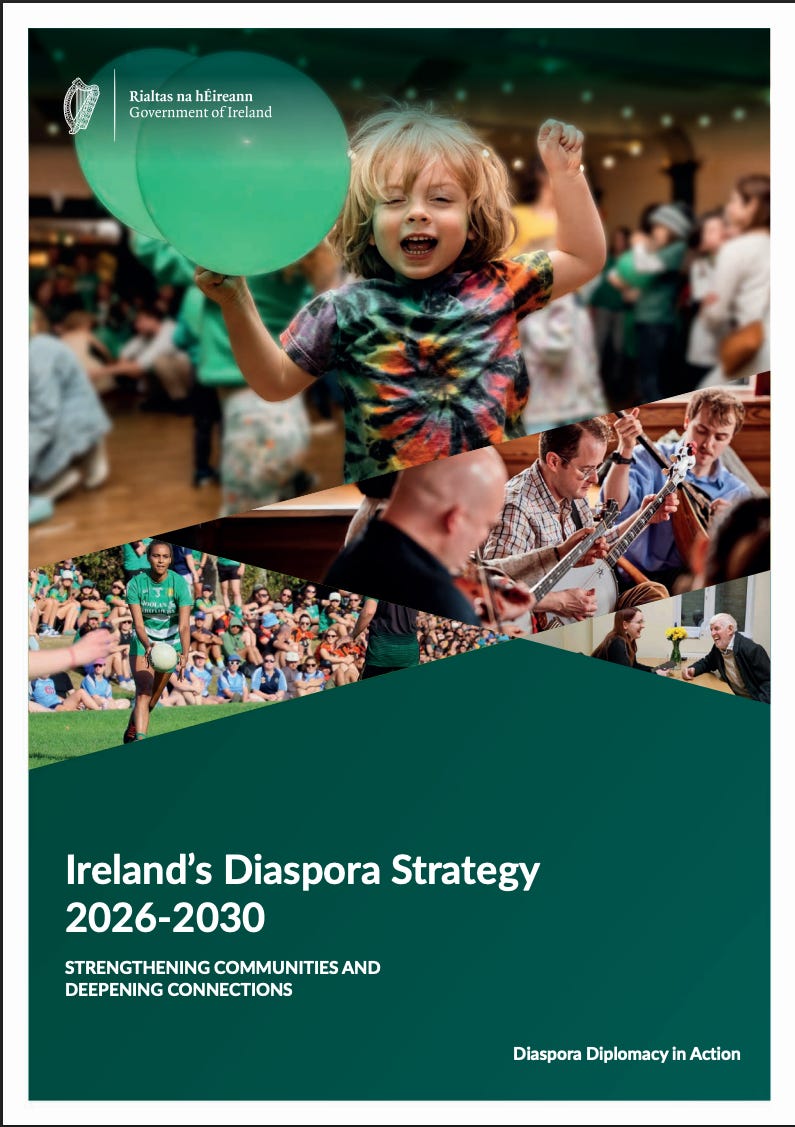
There is a lot to unpack in the Strategy but two lessons, so to speak, struck me as essential. First, it is the holistic methodological approach that led to IDS’s publication. This manifests itself through how Ireland defines its diaspora as well as the data collection and interview processes justifying the report’s conclusions. Second, it is Ireland’s explicit statement on assuming responsibility for its diaspora’s well-being and the country’s open commitment to cooperation. In fact, the 23 policy solutions in IDS are styled as the government’s direct commitments to the Irish diaspora.
Let’s begin with the definitions. Right on the first pages of the report one reads:
“Our definition of diaspora is broad and inclusive and continues to encompass citizens whether born on the island or abroad, those with Irish ancestry, and those who hold a strong affinity to Ireland, including a growing number who have spent time in Ireland and returned to their country of birth.”
This short statement nails down the inclusivity of the modern Irish identity and diaspora as a concept more generally. Diaspora is a complex phenomenon, where migration alone is just a first necessary step. For Ireland, ancestry matters but so does one’s significant engagement with the island, whether that might be in professional or more personal terms. National or cultural identity is often, not always, retained for several generations since the initial migration. The personal circumstances of the descendants of the first migrants in a household, often determine ancestral identity’s strength and relevance.
In the case of Ireland, the Strategy brought up a memory of a co-worker, from over two decades ago, who spent part of one summer preparing paperwork and applying for Irish citizenship. It was indeed a “paper-work” process back then as these days much of the same can be done online. Now, that person was born and raised on Long Island, NY (taking the Hampton Jitney from Manhattan every Friday in the summers) and, at most, visited Ireland couple of times. Fully American, their only connection with the ancestral homeland was through a grandparent born on the island of Ireland. But the ancestral memory seemed to have played some role.
My co-worker was not an exception. True to a long-term trend, today there is strong interest among Irish-Americans in acquiring Irish citizenship and in ancestry-based relocation back to Ireland. According to the U.S. Census Bureau, as of 2024 over 32 million Americans self-identified themselves as having Irish ancestry with another 2.5 million reporting Scottish-Irish ancestry. People of Irish ancestry now live across the world, with the worldwide Irish diaspora accounting for almost 70 million… Population of the island of Ireland? It has recently crossed over five million people.
Bridging this home-diaspora population gap, the Strategy’s authors leveraged a mixed-methodology approach in their research. With over 10,000 raw responses, the Global Irish Survey sits at the foundation of the bigger analysis. The survey supplemented 27 formal in-person consultations across 17 countries. On top of it all, the IDS benefited from a set of 40 thematic position papers that addressed a broad range of diaspora-related questions, some of which were not captured in the survey.
Diaspora surveys, as incomplete as they might be, are informative and essential as the information collected through such exercise offers directional guidance to policy making (as I’ve discovered in my own iterations of two Armenian diaspora surveys and recent Lebanese diaspora survey). And through this fact-finding approach, Ireland accomplishes what some in today’s diaspora engagement field may have said but few have pursued to study systematically. What I have in mind here, is the IDS’s recognition of the heterogeneity of the Irish diaspora, its broad geographic spread, its multi-generational determinants, and the massive scale of its diverse potential contributions to Ireland’s development.
It has become a cliché, of sorts, in diaspora studies (outside of history and sociology, where analysis is usually more informed) to claim diaspora as culturally and patriotically monolithic when it comes to ancestral home country engagement. But even a cursory study of diaspora would reveal the opposite. Any diaspora, comprised of recent emigrees and the descendants of prior generations, is a much more intricate non-linear complex multi-varied phenomenon. It appears that Ireland recognizes this complex non-linearity in how it sees its diaspora—again, an outcome that is empirically confirmed by way of comprehensive analysis, including with surveys.
The second point mentioned above refers to the country’s commitments to its diaspora. A confirmation comes through IDS’s formal statement:
“[T]he Government recognises the duty of care we have to all Irish people abroad. For this reason, a people-centred approach remains the cornerstone of our diaspora engagement.”
This is a pivotal statement in diaspora engagement sphere. A sovereign state willingly takes on responsibility for the well-being of its compatriots living abroad, no questions asked. Indeed, this is a lesson to be learned across emerging markets and developing economies. There, it is often common to see a home country expecting commitments from their diasporas rather than offering a mutually responsible and beneficial path to rapprochement, engagement infrastructure that would rest on trust. In other words, for many, the “first-move” is usually that of diaspora’s and not the country. In this context, Ireland’s resolve and commitment to take the first step is of paramount consequence for today’s diaspora policymaking.
In fact, this is nothing new for Ireland. Back in 1919 the still unrecognized Republic of Ireland pushed the diaspora frontier early by issuing what amounted to the first diaspora bond, appealing to compatriots in North America (for anyone interested, here’s a paper with additional context on diaspora bond as a development policy tool). Today, the Strategy seems to be continuing Ireland’s tradition as a pathbreaker in diaspora engagement.
Consider the fact that the outcome of the document is a set of 23 thoroughly defined commitments, each with sub-sections and action items. These are structured as objectively measurable targets. Ireland’s flagship diaspora engagement initiative, the Emigrant Support Programme (ESP), is recognized as central to the home-diaspora productive connection. The ESP, established in 2004 and run out of Ireland’s Department of Foreign Affairs, has through its monetary grants to non-governmental organizations across the world been supporting the Irish emigrants abroad, strengthening diaspora communities and building meaningful connections with the island.
Perhaps one more quote from the Strategy is due before closing:
“Our Overarching Commitment: Over the course of this strategy, we will work with the diaspora to ensure our relationship with the global Irish communities is a dynamic one that meets their needs and can adapt to evolving circumstances.”
What the above encompasses, at least for Ireland, can be summarized as follows. The country takes upon itself to support the well-being of Irish communities abroad; Ireland’s strategy is to help build, nurture, and maintain Irish identity through cultural and educational programs of various types, especially engaging young Irish across the world, as well as support learning and use of the Irish language. There is also recognition of the Irish diaspora’s direct positive feedback into the economy as well, as the history of The Ireland Funds proves.
To be fair, Ireland is certainly not alone in recognizing diaspora’s potential, especially in terms of economic development. The geography of successful cases ranges from China to Mexico, Philippines, Brazil, and elsewhere. In my experience I have written on diaspora engagement policy priorities for Armenia and separately for Moldova. And lest one forgets the spring 2023 publication of the impressive Scotland’s statement on its diaspora, Scottish Connections Framework. The academic and applied policy literature is quite rich.
And yet, Ireland’s Diaspora Strategy is in many ways unique. Indeed, through this report, Ireland reveals itself to the world as a small country but one with a well-thought through big nation strategy. The country is ready to listen, absorb, and act on constructive platform involving all key actors. It is the necessary trust building exercise that leads towards pragmatic engagement infrastructure by way of shared identity.
The Strategy is an operational blueprint that has been vetted by its stakeholders. And the participatory approach in devising Ireland’s Diaspora Strategy is a sign of Ireland’s institutional maturity as well as its diaspora’s strong involvement in the island’s long-term prosperity.
There is a lot to learn from Ireland’s Diaspora Strategy for all and hopefully those lessons will land on fertile diaspora engagement grounds elsewhere.