

[this a revised reprint from an earlier post on the Monetary Policy Institute Blog found here; new thoughts, charts and data added; including some edits. A bit long but can be of general relevance to anyone interested in macroeconomic development, commodity markets, currencies, and development again.]
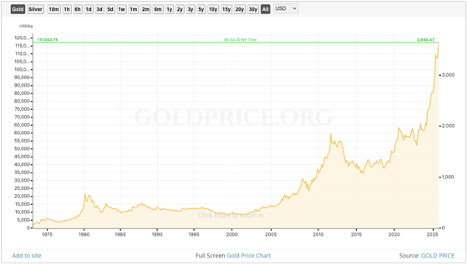
Source: GoldPrice.org (Sept 15, 2025) https://goldprice.org/gold-price-chart.html
If there is one expectation about the global economy that appears to be universally shared, it is that the recent rise in the price of gold will continue its unprecedented trend into the near-term. Breaching approximately $3,640.00/oz at the time of writing this post, some forecasts are seeing $4,000 per ounce by June 2026, according to this Reuters report.
Whether that represents a fair price, reflects correctly on the global market’s demand and supply or speculative trade, geopolitical uncertainties, or central banks across the world fleeing to a safe heaven is a question for a separate and probably longer conversation. Incidentally, though, with my colleague Tarron Khemraj we have written on the role gold may play in emerging markets’ central banks’ reserves as an instrument of a dual aim policy: exchange rate targeting (and controlling for imported inflation) and/or maximizing returns on the international reserves portfolio (full paper here and a short write up here).
For now, few topics in international macroeconomics are as fascinating as those of primary commodities and currency exchange rates. If treated as financial asset classes, an investor outlook, both offer massive profit opportunities for every intermediary involved, though countries of origin may not be as lucky. If treated as instruments of macroeconomic development, both raw materials and exchange rates become indispensable in molding the foundations of a small economy’s structure.
In either case, trade in commodities and currencies has become the epitome of the modern economy, which depending on the reader’s perspective may at times be seen as globalized or fragmented. Trade in agricultural, metal, energy and other commodities stretches back into the millennia of human history from the ancient Sumerians to the Romans, from the fabled Silk Road, then over to the vast merchant networks of the medieval times and to today’s oligopoly of few large commodity trading firms pushing the known boundaries of modern brinkmanship and financial innovation and emergence of the financialization of commodity markets. The logic of buy low - sell high has withstood the storms of time, transforming the operational, financial, and logistical forms of commodities trade.
The supply side is as important as the demand side topped with the speculative price formation. The past three decades have seen a surge in commodities trade, which has also created two phenomena: frequent price fluctuations in the global commodities markets and a condition of commodity export dependence characterizing largely developing economies and emerging markets.
While there has been a marked increase in dollar terms (and most commodities are priced in USD) over the past three decades, the period has been characterized by strong price volatility, as documented in the International Monetary Fund (IMF) that provides historical data on commodity prices. Complementing the price changes has been an overall increase in the overall volume of commodities traded these days.
The earlier consensus placed much attention to the growth of the economies of China and others, especially in the early 2010s in explaining the rise in global demand for raw materials. There can be no doubt that rapid growth across emerging markets and unprecedented expansion of the industrial capacity, primarily in China, contributed to this increase. At the same time, new discoveries across the world, including increased production in crude oil and shale natural gas in the U.S., as well as coordinated efforts by the Organization of the Petroleum Exporting Countries (OPEC) have on various occasions saturated or depleted the market, impacting the price of the world’s key commodity – crude oil – in one direction or the other.
The often-unpredictable interaction between large demand shocks and slower moving supply responses (one would consider, weather and such events as the pandemic and geopolitical tensions as relevant here as well) have contributed to the commodity supercycles—periods during which commodity prices are consistently elevated from their long term averages, often resulting in an eventual collapse, better known as the boom-bust cycles.
An important element in the price volatility of recent decades has been the rapid financialization of commodities markets, defined as increasing influence of market participants with limited-to-no interest in physical supplies hedging but more focused on the commodities as an asset class, i.e. financial returns. Since the early 2000s the phenomenon was characterized by a predominant role of the institutional funds with an estimated inflow between 2000-2008 of up to $200 billion of new investment. Even, despite some recent analysis pointing to possible ‘de-financialization,’ possibly due to growing institutionalizations of trade in commodities and currencies, the impact on price movements from such speculative activities has been quite substantive.
This suggests that primary commodity producers across the world may not always be on the winning side. Production or quality of the product is not sufficient to guarantee positive feedback into a developing economy but financial intermediation (often, speculative) based on the traders’ interpretation of the future may play a more substantive role in the export revenues flowing back to the exporting country. Moreover, there appears to be now a sustained environment of higher commodity prices but slower growth in the global economy, including among commodity exporting countries, as the World Bank notes in last year’s analysis.
This brings now to the point on commodity dependence. According to the UNCTAD a country is commodity dependent “if more than 60 per cent of their merchandise export value comes from commodities.” According to the latest available report almost all countries in Africa, entire South America, and much of Eurasia are defined as commodity dependent countries (CDC) by that methodology, irrespective of their other exports.
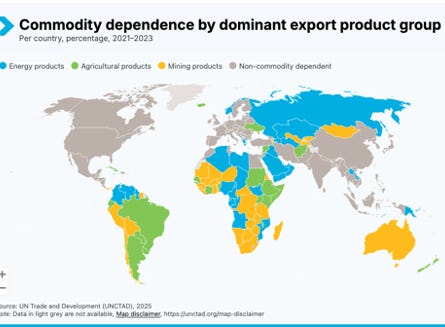
Source: UNCTAD. 2025. The State of Commodity Dependence
https://unctad.org/publication/state-commodity-dependence-2025
For a developing nation, the political economy risks are obvious and are well familiar to the readers of this blog. The basic postulate of the Prebisch-Singer hypothesis—that of declining price of primary commodities relative to manufactured goods (the worsening of relative terms of trade)—remains the key characteristic, acquiring new dynamic features of our time. It is important to emphasize here the ‘relative’ deterioration of the terms of trade, despite the generally rising commodity prices in absolute dollar terms, as noted above.
As such, the most vulnerable, structurally weaker, CDCs are susceptible to price shocks (on top of supply interruptions of imported commodities) with far-reaching impacts to their macroeconomic stability domestically and externally, especially as that relates to the sovereign debt sustainability and costs of borrowing. Related, is the risk of reversing international capital flows to the emerging markets’ CDCs that are more exposed to the trends in the commodity markets. This is an essential concern for little-diversified exporters with approximately 80 percent or higher shares of their merchandise exports tied to the extractive commodities sectors. The latter tend to characterize low-productivity domestic economic environment with high indicators of unemployment, poverty, inequality, and macroeconomic policy inefficiency. In the end, the small CDC developing economies end up in a perpetual effort of catching up with more industrialized nations, which, ironically, also rely on their share of commodities exports.
One popular proposal to overcome this has been resurrection of the idea of commodity buffer stocks. Initially discussed in the aftermath of World War II and strongly supported by John Maynard Keynes and even Friedrich Hayek, today’s advocates argue that creating buffer stocks will help alleviate inflationary and supply pressures across the developing world. Paradoxically, exporters of some of the world’s most demanded raw materials often face either a deficit of those products or (and) are unable to afford much of manufactured imports. Challenges to implementing these ideas range from supply side procurement, to governance, fiscal and monetary policy capacity of developing economies able to finance the undertaking, to the lack of the global operational consensus around administration of such an ambitious program. Lest, one forgets the power of the international capital markets and global commodities trade mentioned earlier.
And then there is another factor—that of the dominant currency. Some may be familiar with a rich literature on hegemonic currencies and the dynamics in the peripheral currencies and currency hierarchies. These discussions touch on policy capacity, monetary sovereignty, and the macroeconomic aspects of economic development across small economies. In fact, IMF data suggests that for majority of commodity exporters in the emerging markets and developing economies, mostly the CDCs per the UNCTAD’s methodology, the main invoicing currency in their international trade transactions remains to be the U.S. dollar. To top it off, much of the today’s commodities financial derivative contracts are traded on the Chicago Mercantile Exchange Group and the New York Mercantile Exchange, which bears an implicit intrinsic value and influence of the USD in a final price determination.
A recent analysis finds that a positive shock to the USD (appreciation) has a negative impact on the commodity dependent economy (price of its exports rising, reducing incoming foreign exchange revenues). Here, GDP contracts through an indirect bilateral exchange rate level and any drop in commodity prices comes on top of that, worsening the terms of trade further, as per above. A commodity price shock may worsen the foreign exchange constraint of a developing economy, exacerbating the macroeconomic shocks described above.
In that, the macroeconomic complexity of commodity dependence remains the core factor shaping the economic development outcomes of the small open economies. As a result, most of the small open economies may eventually be facing a developmental challenge (and most prominent examples aside, this is also relevant for the small post-socialist economies of Eastern Europe, Caucasus, and Central Asia).
The challenge here is for the affected economies to come up with a sound, solid, and flexible/diversified macroeconomic development model, escaping being an aside to global investors’ portfolio rebalancing. Such model would be bravely advancing a range of development levers and new technology, from big-push approaches, to trade alliances, to diaspora engagement, and, finally, pushing through institutional improvements leveraging commodity revenues.
While much of the industrialized world stands only to benefit from such hypothetical long-term developmental improvements, in this struggle, the smaller economies are likely to be on their own in charting their macroeconomic destiny. Hence, more pressure on hard and well-thought through strategic [industrial?] development / growth policies.
In the meantime, one thing is clear -- commodities prices will continue in their volatility.
###