


[much thanks for their understanding to colleagues who are better equipped with technical terms appearing here and that required some explaining in an effort to make the text informative for all]
For foreign exchange-strapped developing nations borrowing in the international capital markets, comparative ratings of their debt profile determine whether a country appears on the global investors’ map or not. Three credit rating agencies (CRAs)—S&P, Moody’s, and Fitch—are responsible for much of the global sovereign ratings (approximately 90% - 95% of all ratings). All three, recently, updated their views on creditworthiness of the two small economies tucked in the mountains of the Caucasus—Republic of Armenia and Republic of Georgia (for a general credit rating methodology explainer see this video here).
On July 28, 2026 Moody’s announced that it was affirming Armenia’s Ba3 rating and changing the country’s outlook from stable to positive. One month before this announcement, on June 30, Moody’s affirmed Georgia’s Ba2 rating and changed the country’s outlook from negative to stable. With these announcements Moody’s actually followed its two competitors, affirming the rating but improving the outlook (e.g., here’s Fitch on Armenia and Georgia). With debt as an unalienable part of our global economy, what is the macroeconomic significance of these seemingly technical updates?
On balance, the news is positive. This is so even despite the fact that the two small open economies remain at below investment-grade levels across all three CRAs (for Moody’s the minimum is Baa3 rating). This impacts domestic finance, as well. A country ceiling—the maximum rating an economy achieves in a given environment—is essential for the domestic debt-issuing private sector, from banks to retail trade and others.
The below investment-grade (or speculative; “high yield” with a higher risk of default) designation is a restricting conventional reference for large international institutional investors, indices, banks, and other financial market participants. And so, for a sovereign borrower a rating of at or above investment-grade threshold opens up far greater capital financing opportunities.
For Armenia and Georgia this means there is still a lot to be covered before full embrace of the global capital markets is possible. This distance between the investment-grade threshold and their current rating position is clearly visible in Figures 1 and 2 that plot a chronological sequence of Moody’s ratings and outlook changes for both countries. Note that Moody’s started rating Armenia as a sovereign issuer in 2006 and Georgia in 2010. While the terminology differs slightly between the three CRAs, the essence remains the same—what’s rated is the ability and willingness of the national government to comply with its financial obligations to its creditors, including local and foreign currency debt.
Figure 1. Armenia: Moody’s Long-Term Sovereign Issuer Rating
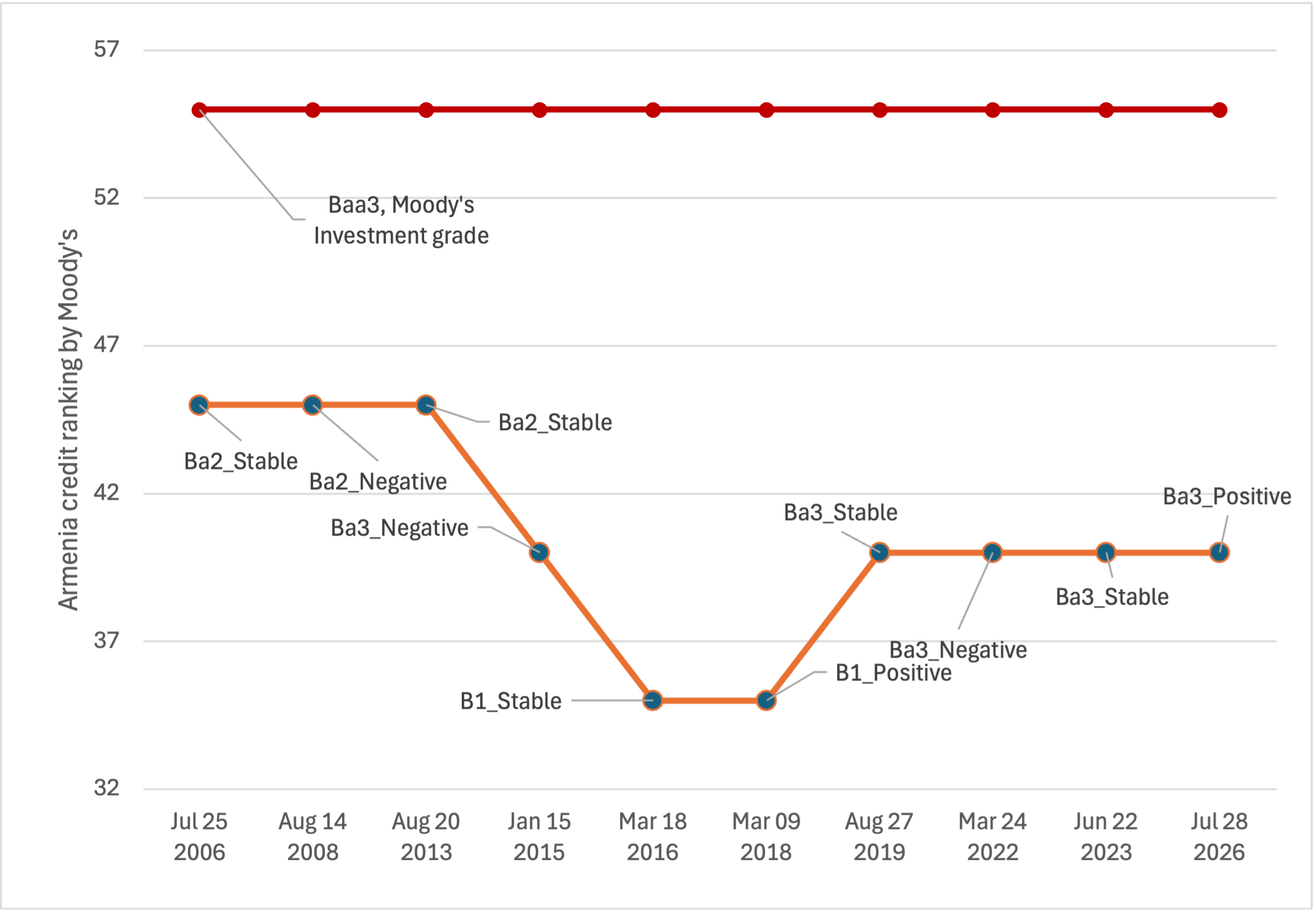
Figure 2: Georgia: Moody’s Long-Term Sovereign Issuer Rating
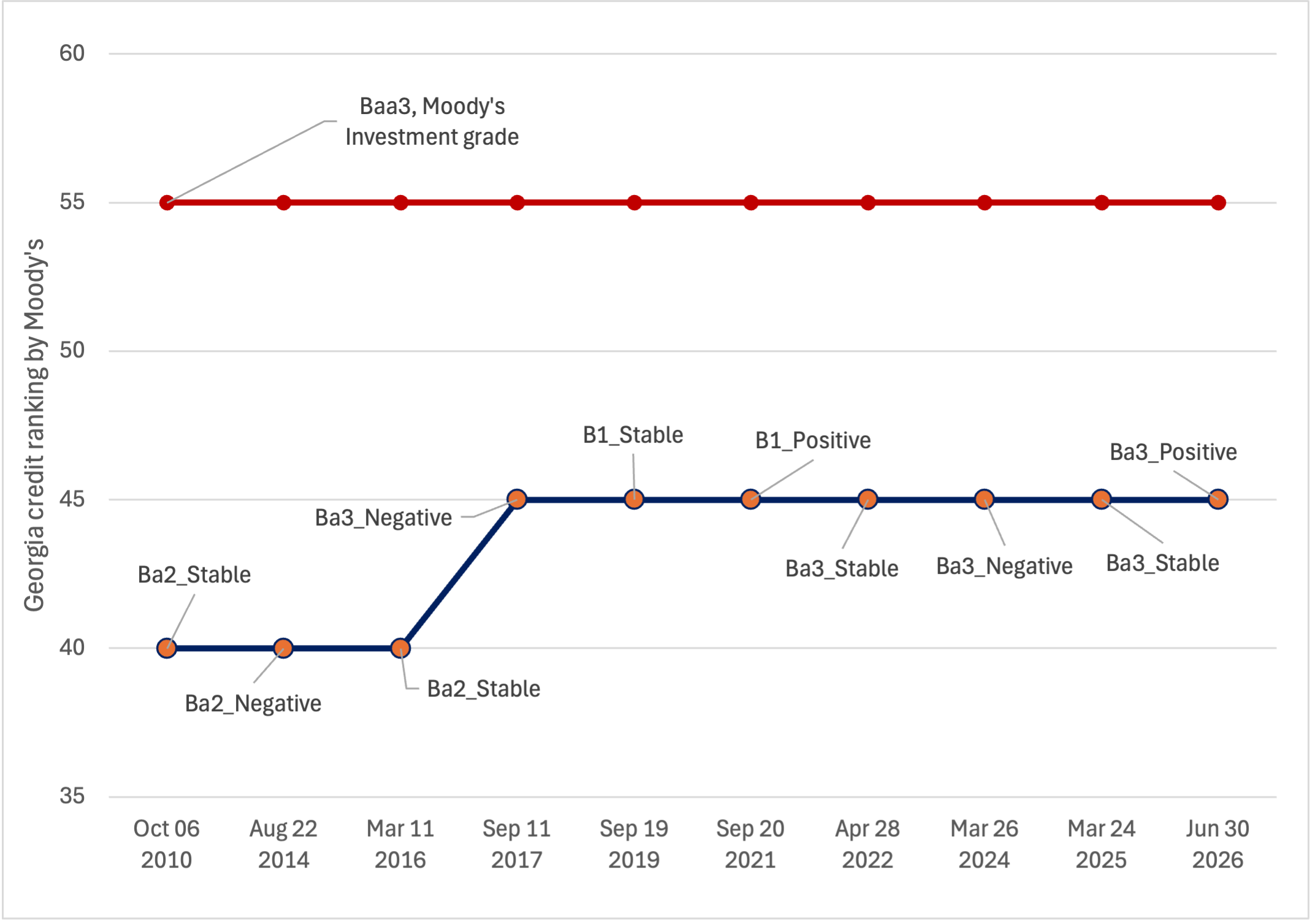
To make these graphs work, Moody’s letter-scoring was converted into numerical values using Trading Economics conversion tables. So, in effect, according to Moody’s ratings, Armenia is three levels below (Ba3→Ba2→Ba1) and Georgia is two levels behind (Ba2→Ba1) from the investment-grade threshold (Baa3). Other CRAs provide similar assessments (e.g., Fitch’s current rating for Armenia is BB- and for Georgia it is BB, both below the investment grade BBB- threshold requiring Armenia to climb three and Georgia two levels up). A speculative grade rating does not necessarily prevent a country from borrowing in the international markets but, as mentioned above, it does limit its ability to tap into larger financial capital resources and to contract at lower borrowing costs.
Elsewhere, related questions had been explored in a UNDP-Africa 2023 report on sovereign credit ratings and macroeconomic development (to which I contributed initial background analysis). At the time, report’s crucial finding was that even minor changes in sovereign credit ratings (and, implicitly, outlook revisions) had significant financial impact for the borrowing nations.
The UNDP report cited “idiosyncrasies” in the CRAs ratings decisions, the gist of the criticism boiling down to the agencies’ methodology and misinterpretation of fiscal spending in a developmental context, due to lack of country-specific expertise. As a result, the cost to the African nations was estimated to be at $74.5 billion with $46bln in opportunity cost of forgone additional capital and $28bln in extra interest payments due to higher borrowing rates.
Figure 3: Development Costs of Credit Ratings Idiosyncrasies in Africa
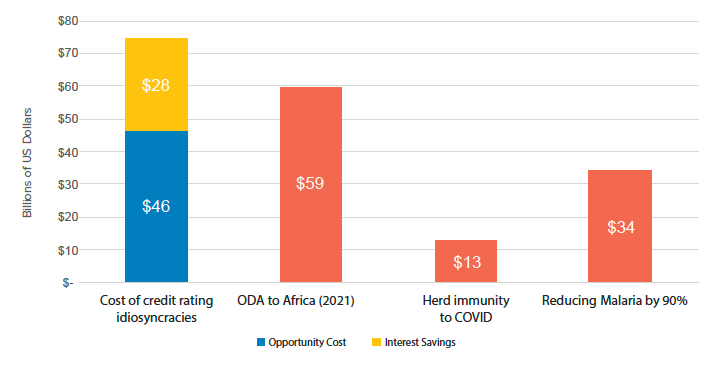
Figure 3 contrasts the report’s findings to Africa’s financial spending on COVID immunization, efforts on reducing malaria by 90%, and development aid received in 2021. A recent update from UNDP-Africa finds that majority of the countries on the continent are below investment-grade, which leads to a premium on their borrowing costs or even punitive rates for the unrated countries. Popular disagreements with the CRAs on sovereign ratings, often leading to calls for revisions of the methodologies or for countries to write their own credit stories, as Daniel Cash suggests, are often discussed in economic development academic and policy literature.
The above observations are informative for the two countries in the Caucasus (but also other small post-socialist economies). As costs of borrowing subside, following improvements in ratings, financing becomes more affordable, likely motivating new domestic entities to enter the capital markets. Savings resulting from all that may be directed towards economic development promoting projects or business expansion.
Between the two, there is a difference in benchmark spreads on Armenia’s and Georgia’s USD-denominated bonds (as reported by the Ministry of Finance of Armenia and the Ministry of Finance of Georgia). Georgia’s spreads are substantially lower (in the 151 to 207 basis points range) than Armenia’s (in the 242 to 286 basis points range), which is also reflected in Georgia’s better than Armenia’s overall sovereign rating. Among other factors, a successful bond redemption should then help drive the sovereign rating higher and borrowing costs (reflected in benchmark spreads) lower.
But there is more than just debt redemption or macroeconomics that drives the ratings. In their latest updates, all three CRAs reflected on the internal and external political situation impacting their rationale for the outlook revisions in the Caucasus. In Georgia attention was attributed to the country’s stabilizing domestic political situation and sustained relations with the European Union as having lesser risk of negative economic impact.
In their statement on Armenia, Moody’s makes a direct reference to the country’s uneasy geopolitical challenges with expectations of peaceful regional stabilization following the August 2025 US-brokered agreement between Armenia and Azerbaijan. Similarly, results of Armenia’s June 2026 parliamentary elections are said to support “policy continuity” and sovereign rating affirmation, as stated by Moody’s. Fitch goes a step further mentioning removal of “constitutional references to Karabakh” as “posing a source of lingering uncertainty in the peace process”.
It is quite logical for CRAs to account for the political, whether external or domestic, drivers of their sovereign credit ratings. That is part of the ratings model that for Armenia and Georgia, observers familiar with the region might say, can be somewhat visible in Figure 1 and 2 above. And if politics could be so unpredictable, especially in the Caucasus as the past six years show, why bother with debt repayments and credit ratings after all? The answer is that behind the political veil, economics still drive much of the process.
In his book, Why Not Default? The Political Economy of Sovereign Debt Jerome Roos offers a comprehensive structural analysis of today’s debt markets with a solid analytical backing from economic history (my review of the book for LSE Review of Books). He observes that the frequencies of sovereign defaults have substantially declined. Roos says there are three mechanisms at play that explain the phenomenon. All three are relevant to the present discussion.
First mechanism is the international capital market discipline. In the event of noncompliance (e.g., missed interest payments or abandoning debt repayment responsibilities), international investors may act uniformly penalizing the debtor by withholding additional credit or raising the risk premia. Roos argues that structurally, global capital markets have shifted towards higher concentration imposing such a synchronized discipline conditions on the borrower.
The second mechanism emanates from the infamous conditional lending, most recently manifested in the Greek debt crisis. The International Monetary Fund’s (IMF) participation as a lender of last resort has become instrumental. According to Roos, this is now a pre-requisite of sorts for private investors before re-engaging with the sovereign borrower. Incidentally, in both Armenia and Georgia concessional lending from multilateral organizations remains to be an important factor, which provides some hypothetical cushion against the frivolities of the bigger market.
But it is the third mechanism that I find most intriguing when studied in the cases of Armenia and Georgia. Pressures to comply with sovereign debt obligations and maintain the sovereign rating may also emerge from the domestic business (and to some extent, political) interest groups. Dependent on the CRA’s country ceiling, these domestic players (and one can think of a couple of representative sectors in both Armenia and Georgia) also borrow and compete for foreign capital inflows into their domestic operations. As such, their positions on government finances, either through political lobbying or economic forms of engagement, could potentially be influencing broader national political economy decisions.
For structurally and institutionally weak economies the challenges to stay on course of their macroeconomic development programs (assuming such exist) are too real to omit from analytical consideration. Taken together, the above three mechanisms reinforce private creditors’ outsized powers, as external and internal pressures ensure debt repayments and, often, forcing even new governments that come to power to honor their predecessors’ commitments.
Sovereign defaults may still happen but for that all three mechanisms must collapse. In all three mechanisms, the CRAs with their credit ratings and forward outlook updates are integral components of the global debt markets.
The news affirming sovereign ratings and forward outlook upgrades for Armenia and Georgia is a welcome step on the long arduous path of post-socialist macroeconomic development. Maturing capital markets suggest lesser reliance on multilateral coordination (e.g, by way of the IMF) and, instead, increasing cooperation with the global private investor groups. These CRA announcements may also help domestic corporate sector—that has grown in its systemic importance to the local economies—to gain added leverage with the brutally competitive international capital markets.
And, undoubtedly, if these ratings help bring greater foreign exchange into both countries, prompting deeper integration with the global economy and sustained domestic macroeconomic advancement (with attention to questions of balanced and socially inclusive growth) that would be timely and much needed.
Yet, despite high-level improvements, macroeconomic capacities of Armenia and Georgia remain limited and constrained by a host of external and internal factors. Moreover, geography and geopolitics are as significant of determinants of any success in the region as are technical indicators of economic growth and balanced fiscal budgets. Reading the latest CRAs updates, it becomes clear that the fragility of the political economy determining the sovereign credit ratings and their impact on the said macroeconomic development can also be on the emerging discussion agenda.
As for debts in the mountains, sooner or later, all debts made there are repaid. The question is probably about the effort that would be required to settle those debts…