


[this began as a letter to FT.com hence the reference to one of their articles]
As to the US dollar’s gains in value at least since 2012, so clearly visible in this FRED’s chart (& below), there is a disproportionate amount of op’eds and media coverage of financial outcomes for global investors and strategies of portfolio reallocation out of the emerging markets funds into USD denominated assets. Harriet Clarfelt’s article (“Dollar’s surge sparks biggest fall in emerging market currencies in 2 years”, FT.com, December 12, 2024) offers a clear analysis of the related trends.
Indeed, one must follow the money. But are we (again) politely avoiding a more difficult conversation on the dominant currency’s macroeconomic impacts on small economies?
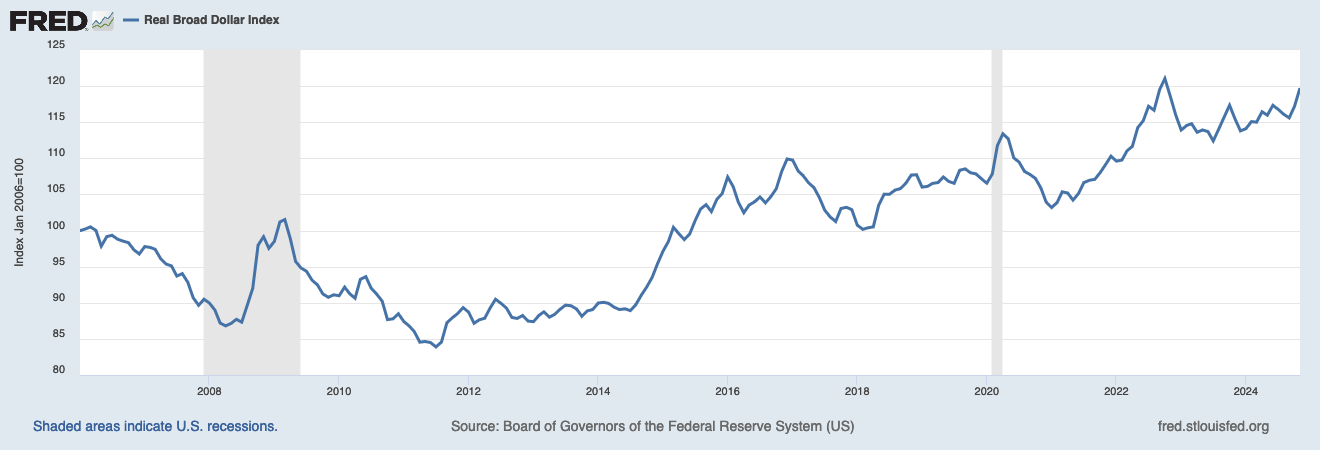
The US dollar is the international reserve currency, as confirmed in an IMF blog post earlier this year. And so, uncertainty around the USD, with much-anticipated US tariffs of the early 2025, is haunting the global capital. One school of thought sees a US dollar rapidly replaced in international finance and trade with an alternative, lately BRICS or Bitcoin.
Another view is less dramatic, predicting an initial strengthening followed by an inevitable gradual decline in the greenback’s value. That could lead to an increase in the US exports but could also spell a loss in the USD’s reserve currency status, as the share of the USD in the national central banks’ reserves drops (there’s a recent important analysis in FT.com by Barry Eichengreen summarizing these moods above).
With geopolitical challenges and transforming global value chains, investors’ risk-return concerns are prioritized, leaving little time to study USD’s complex aftershocks elsewhere.
Realistically, it is unlikely for any of those scenarios to quickly materialize. Yet, even if any of those scenarios do play out, the USD will continue to be a dominant currency for some time for the structurally smaller developing economies largely exporting primary commodities.
This argument comes back to the “center-periphery” literature at least back to mid 1940s and Raul Prebisch’s work. More recent literature has looked at how strong dominant currency speeds up capital outflows from non-dominant economies into dominant currency priced assets (e.g., the paper by David Fields and Matias Vernengo) with all the subsequent currency hierarchy effects (e.g., see the paper by Daniela Prates).
This year, in our paper with Tarron Khemraj (also, see the journal page) we offer a summary of these discussions by diving deeper into the problem of foreign exchange constraint. Our specific focus is on the Exchange Market Pressure reaction to the USD and the EUR appreciation …but that’s for another place/time…
Among other findings, we conclude that a stronger dollar in relation to others will have a negative macroeconomic effect, measured in shocks to economic activity and growth, across smaller emerging markets.
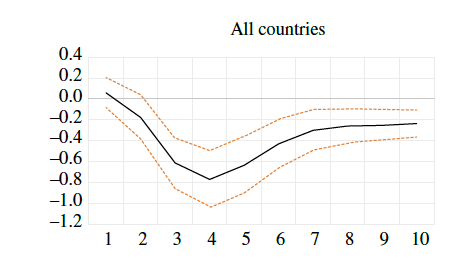
There is an indirect nominal exchange rate shock. With their exports priced in the USD, a stronger dollar makes small economies’ commodities less affordable internationally resulting in lower foreign exchange revenues. In fact, the negative impact from USD’s appreciation on commodity dependent economies (as per UNCTAD’s classification) is much larger, as seen below.
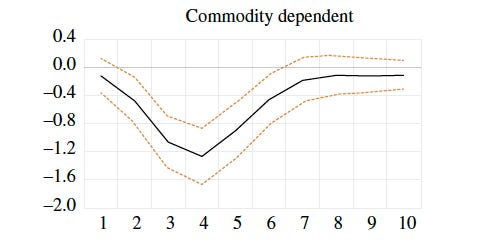
Their manufactured and technology-intensive imports will become more expensive, impacting economic relations among the developing economies. In short, not only there’s a drop in GDP due to the indirect bilateral exchange rate path but there may also be a decline in prices of the primary commodity exports compounding the overall macroeconomic impact emanating from the dominant currency’s appreciation (with accompanying portfolio adjustments).
In turn, low foreign exchange revenues lead to underfunded development projects and difficulties with sovereign debt repayment, with subsequent risks to credit ratings downgrades. That latter effect often results in lower capital inflows and higher borrowing costs, as has recently been shown in a series of studies by UNDP-Africa.
Even for economies with local currency debt, their foreign exchange revenue has provided some risk assurance to the global investor. Inability to sustain those revenues due to a loss of competitiveness driven by appreciating dominant currency, the USD, in the context of weak economic foundations, may lead to a further decline in foreign capital inflows.
As a result, some small developing economies risk ending up in a prolonged underdevelopment trap. And for a more comprehensive take, it’d be good to see colleagues following up on this with more insight and applied work…
For now, what all that means is quite simple and has been known to some economists, especially those working in applied macroeconomic development field (vs. case studies), but probably is not evident as a general concept…
To move forward there is an urgent need to contextualize dominant currency dynamics within the emerging markets macroeconomic structural foundations as the primary topics for specialized analysis and media commentary.
We should not be treating small economies’ development outcomes as an aside to global investors’ portfolio re-balancing trends…
[the above write-up is a draft collection of thoughts and perhaps could benefit from good editing, more structure, and some additional argumentation… but that’s why it’s a Substack…]