

Somewhere in his long and non-linear How Rich Countries Got Rich… and Why Poor Countries Stay Poor Erik Reinert advances an essential (and, at the same time, obvious) point. Nation’s economic progress, he says, should be measured by the type and diversity of final goods and services that the country produces for internal and external markets. This is much more than “any exports are good exports” adage resonating for three decades across small post-socialist economies of Central Eastern Europe (CEE) and those of the former Soviet Union (FSU), where the link between history and present is definitive as reviewed before.

Reinert’s point is consistent with economic complexity and economic complexity index (ECI) credited to the work of Cesar Hidalgo and Ricardo Hausmann, with visualizations via Observatory of Economic Complexity (OEC). The intended idea is that economic complexity captures a critical mix of country’s capabilities in terms of its institutional, social, political, scientific, technological, and industrial productive capacities.
Does ECI show real economic complexity improvement?
The higher ECI value earns a country a correspondingly higher global ranking. Per the latest data, in 2023 Japan earned the highest placement in the world in ECI based on international trade. In 2021 Sweden led in terms of ECI technology (proxied by patents data) and United States in ECI research (proxied by the research publication data).
The CEE / FSU economies are scattered across the rankings but with crucial variances within the post-socialist group (Fig. 1). Contrast two years, 2018 and 2023 of ECI Trade index, can help capturing the effects of various shocks impacting the vast post-socialist geography and global crises, like the COVID-19 pandemic and global value chains reorientation, that would have had most definitely influenced macroeconomic outcomes over the five-year period.
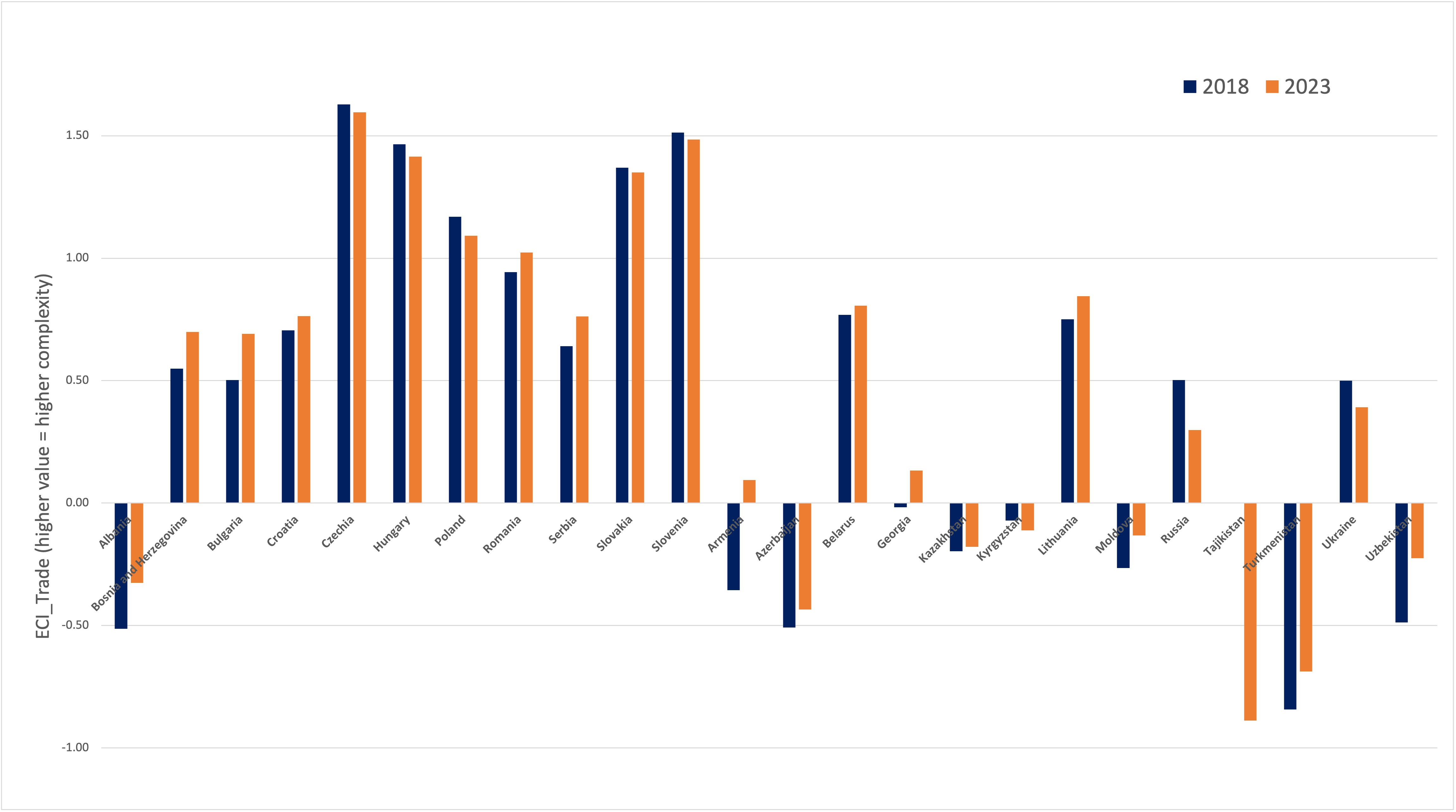
The evidence is clear: almost all (with exception of Albania) CEE economies have higher ECI Trade values, ranking above the FSU group. For anyone paying any attention to the economic history of the region, the explanation for such results should be self-evident.
The CEEs structurally, logistically, economically, and politically are much stronger integrated with the European Union’s economy, which then further supports their individual (to varying extents) macroeconomic productive foundations. Anyone still thinking that the core explanation is linear to the success of the 1990s of reforms, unfortunately, would be disappointed. There is, actually, an IMF paper that illustrates and explains this successful “transformation” in CEE quite well (or read my short letter in FT.com), and Ivan Berend has cautioned against premature celebrations.
The FSU economies, on the other hand, present a mixed picture. The index declined between 2018 and 2023 for Russia and Ukraine as sanctions pressures intensified on the former and economic activity losses accumulated in the latter in the background of the ongoing military conflict. Yet, both have higher ECI Trade values than majority of other FSU countries. Belarus and Lithuania also show high (and improving) ECI Trade values as well as global ranking at 33 and 32, respectively.
But elsewhere, with low index values and low global rankings, there have been at least two sharp trend reversals: Armenia and Georgia. Both countries have seen their index values turn from negative to positive values, impressively moving up in global rankings (Georgia from 61 to 55 and Armenia 77 to 57 between 2018 and 2023 respectively). Added to this are index gains for Kazakhstan, Moldova, and Uzbekistan.
It is, however, important to understand that the main driver in the ECI Trade improvements in the Caucasus and Central Asia (CCA) is not a sudden structural change of productive capacity, a la Reinert’s argument. Instead, much of the trade gains since mid-2022 have been due to increasingly growing complexity of re-exports oriented towards the sanctioned Russian market. The non-linear path of the basic consumer and high-end Western manufactured goods (e.g., the latest models of iPhones or German-made cars) is more obvious in some places (e.g., Armenia and Kyrgyzstan) where Russia has been a historically largest, if not the only, trading partner; and less so clear elsewhere (e.g., Georgia and Uzbekistan) with trade following indirect routes. The OEC visualizations help capture these subtleties in trade volumes comparisons between 2023 and earlier years (e.g. Armenia, Georgia, Kazakhstan, Kyrgyzstan, Uzbekistan).
The possibility that re-exports are skewing the ECI Trade rankings for CEE and FSU necessitates improvements to the methodology of estimating true inherent economic complexity. In my earlier Substack post about the omission of the small CEE/FSU economies in the big Global South conversation, I raised a related point on data interpretation with context. But an extended discussion on this issue is best left for elsewhere.
To continue, the World Bank country offices have covered in their numerous updates the topic of re-exports with subsequent macroeconomic implications for the small economies. In their October 2025 update on Georgia, the World Bank noted that exports to Russia were up 13.2% and to Bulgaria 201% year over year in August, while exports to Kyrgyzstan declined. Similar updates can be found for other countries. Elsewhere the World Bank warned of the headwinds for Armenia’s economy in their July 2024 country update.
That is the main takeaway here: the share of self-produced complex final goods and services in the small CEE/FSU economies remains to be minimal, as much of the high-end exports improvement is exogenous and likely temporary.
Moreover, the ECI Technology (and ECI Research) data suggest that majority of the CEE / FSU economies are underperforming compared to the global rankings. With exception of Russia (ranked 17th globally) and Ukraine (ranked 39th), with traditionally higher innovation rates and advanced science support, other FSU economies are severely lagging behind their post-socialist peers (Fig. 2).
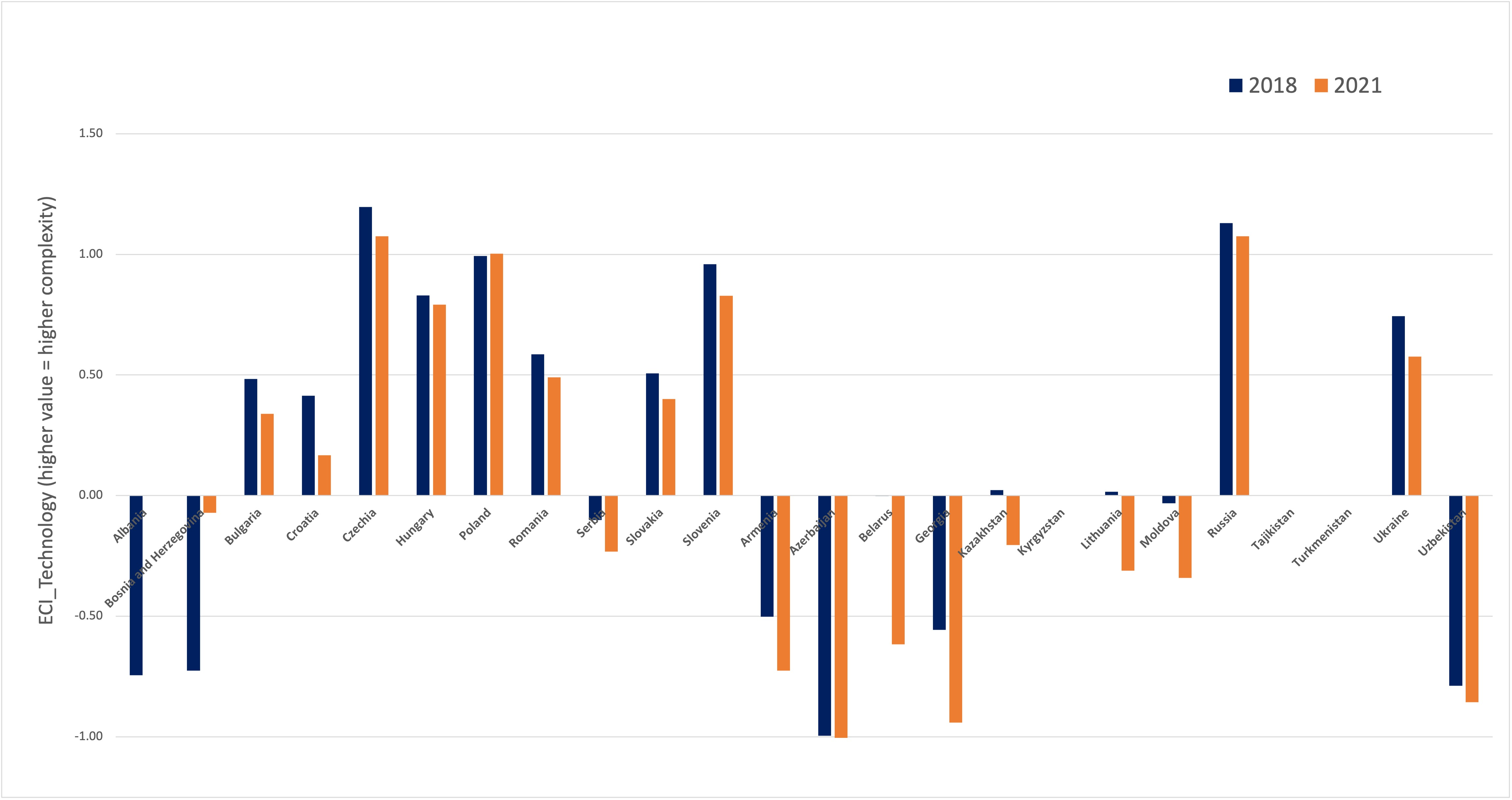
Improvements in the EIC Technology would require substantial financial and policy effort in boosting a country’s technological and innovative foundation. And that requires time. For now, then, there is simply no capacity to produce high-value final goods on a large enough globally competitive scale, leaving the smaller post-socialist economies structurally vulnerable.
Cautious optimism and warnings
Still, the World Bank is cautiously optimistic, based on the expectations of CCA economies leveraging current export revenue surpluses and redirecting funding and capacity towards much needed innovative sector development and institutional strengthening.
The World Bank’s Europe and Central Asia latest Economic Update also mentions increasing private credit/lending and rising labor force participation as possible push factors for growth. The report sees Central Asian economies leaning towards gains in agriculture efficiency and logistical developments “along Eurasian corridors”. A similar expectation applies to the Western Balkan countries with an added role for the tourism industry. Renewable energy investment and “exportable digital services”, as well as, logistical solutions are expected to sustain economic vibrancy in the Caucasus.
Prioritization of the digital services sector, welcome in a small country model, without the corresponding broader economy’s scale is not a sufficient condition for sustained inclusive growth. The International Monetary Fund (IMF) in its latest 2025 Article IV Consultation on Armenia reminds that “…the abatement of transit trade would be a drag on growth…” as export flows to and around Russia decline as geopolitics change, with also a likely reversal of capital flows. Both are massive external shock factors for the affected small post-socialist economies that are lacking a solid complex industrial (manufacturing) core—the brick and mortar of economic development.
The new high-tech sector vs. Reinert’s primitivization
The exciting popular confusion about the future that the Information Communication and Technology (ICT) sector holds for small economies is remarkable in three ways: the naivety of the believers; the disdain of the deniers; and the apathy of the rest. Again, Eric Reinert in discussing the de-industrialization patterns across smaller economies, including CEE / FSU, warns against “primitivization,” i.e. reducing economy to exporting either low-value goods or to a primary commodity exporter role. This certainly in reference to the goods produced inside the country, not the re-exports.
But even with the current emergence of the modern industries, especially in globally competitive ICT sectors, there is limited feedback to the broader fundamental macroeconomic improvements. In the structurally weaker economies “[a]dvanced service industries, however, are dependent on the demand of the old industrial sectors” (p.181), according to Reinert. The critical point here is about how the ICT industry, for instance, is integrated with the rest of the national economy, in which majority of the labor force and economic activity is either in agricultural, trade, tourism, or extractive mining sectors.
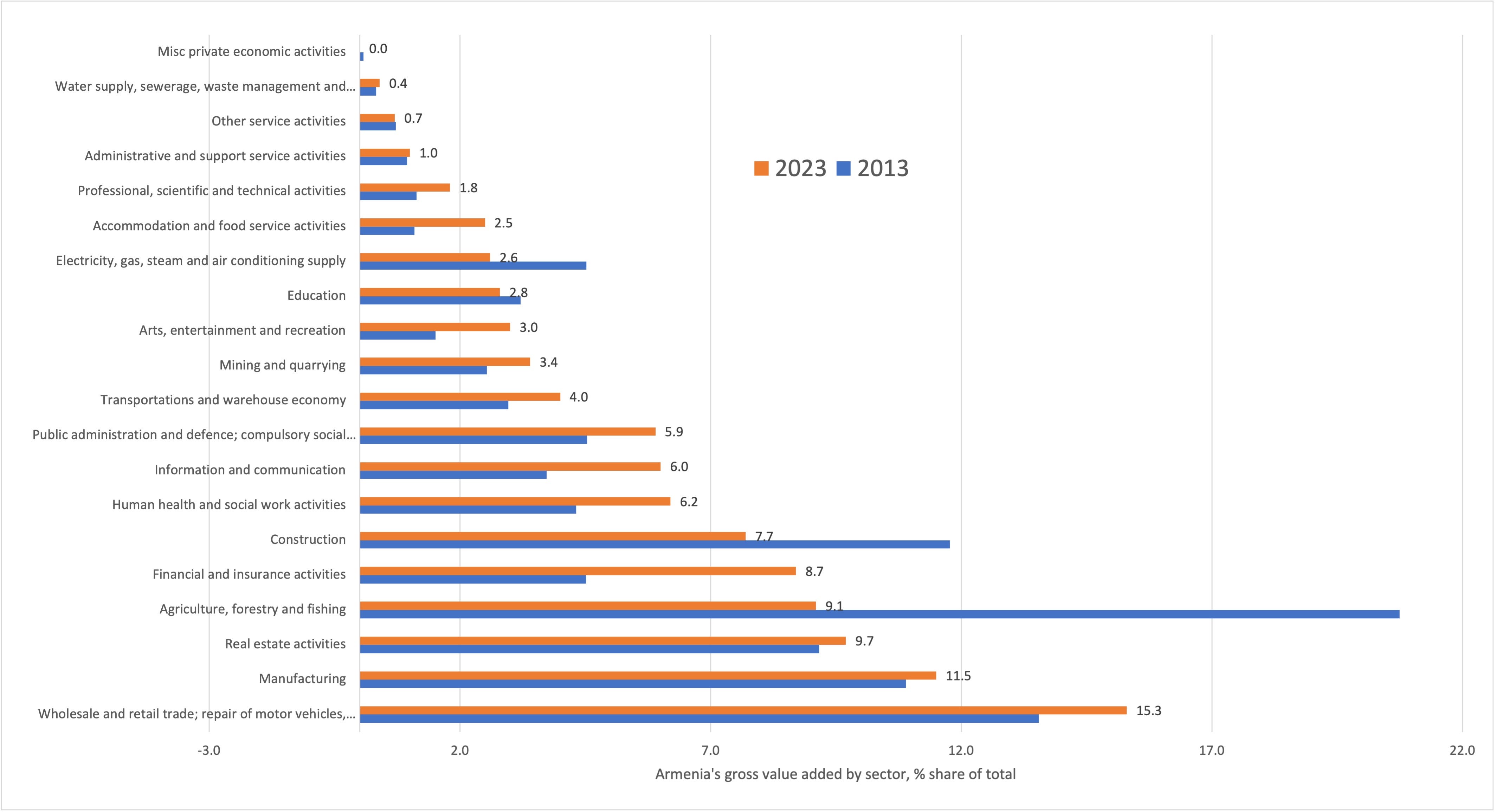
In Armenia—objectively a leader in the tech sector transformation in the region, e.g. the latest Nvidia announcement—such ICT integration is still minimal. The sector adds barely six percent as of 2023 in gross value added to the rest of the economy (Fig. 3). Instead, wholesale and retail trade, some manufacturing, real estate, agriculture, and finance sectors are the largest contributors. But much of the real estate and financial sectors’ growth has come on the wave of the precarious large-scale labor force and business relocations from Russia since 2022, the effect of which has been wearing off in the past two years.
A popular counter-argument is that ICT’s growth has been good for the country’s exports. The evidence points to the opposite. Excluding possible re-exports trends, the exports core of the small economies in the CCA is dominated by the lower-value primary and agricultural commodities. Again, Reinert states that “…no country has ever become rich by exporting foodstuffs without also having an industrial sector” (p.166). This is in reference to the loss of a technologically complex urban economy (perhaps, never to be recovered). While specific ICT engaged firms may be enriching from the external trade, the gains remain outside of the broader economy.
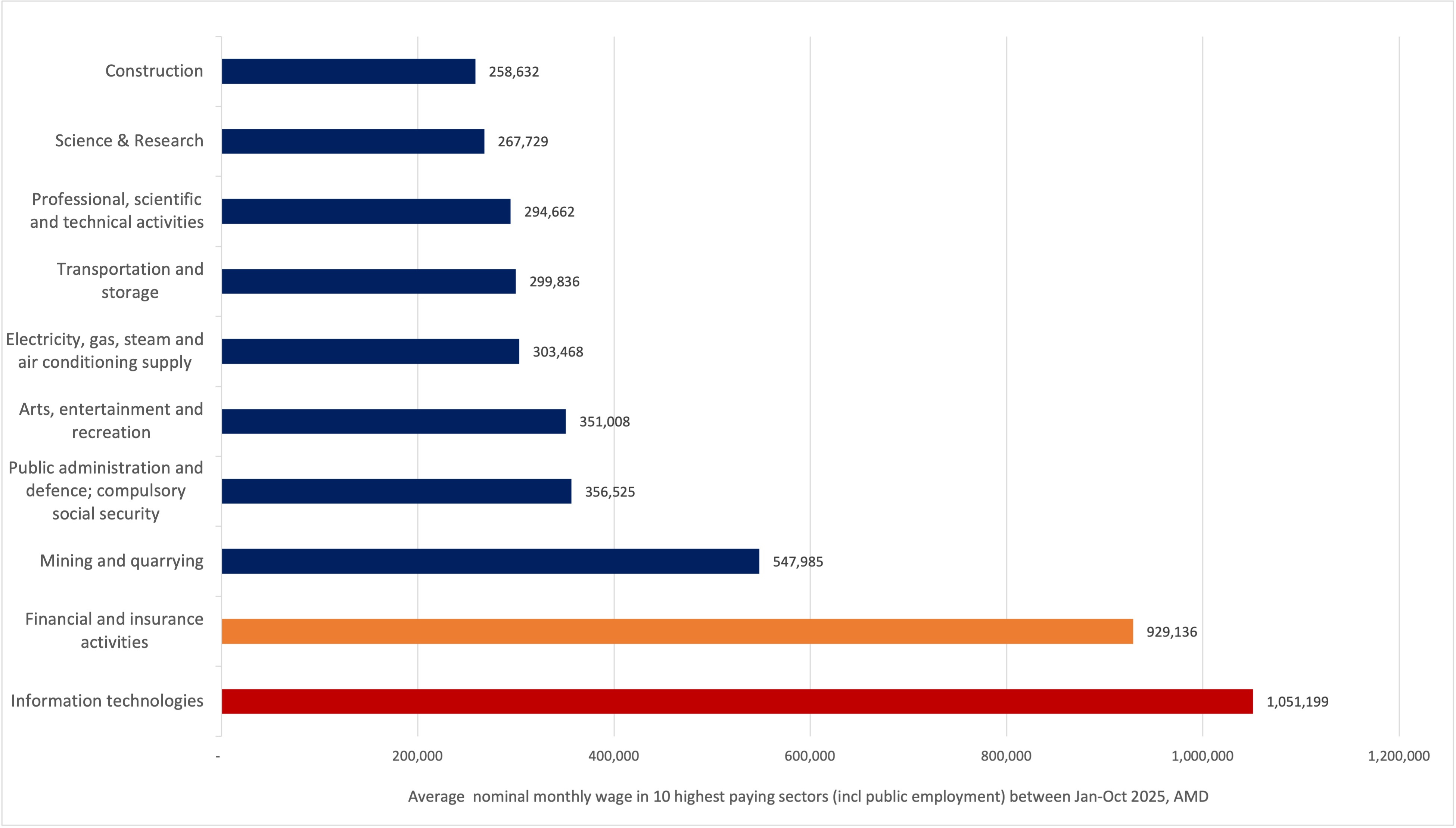
Another popular retort is that the ICT has been net-positive for individual enrichment and wealth creation. To some extent this is true. In Armenia, the average monthly wages in the ICT industries are at least two times higher of the average salaries across other sectors (Fig. 4), financial service is the next closest. The latter is largely a temporary phenomenon connected with capital and labor inflows from Russia, rather than a reflection of fundamental improvement. The contrast with the rest of the economy is startling and the same pattern is true elsewhere, e.g., Georgia.
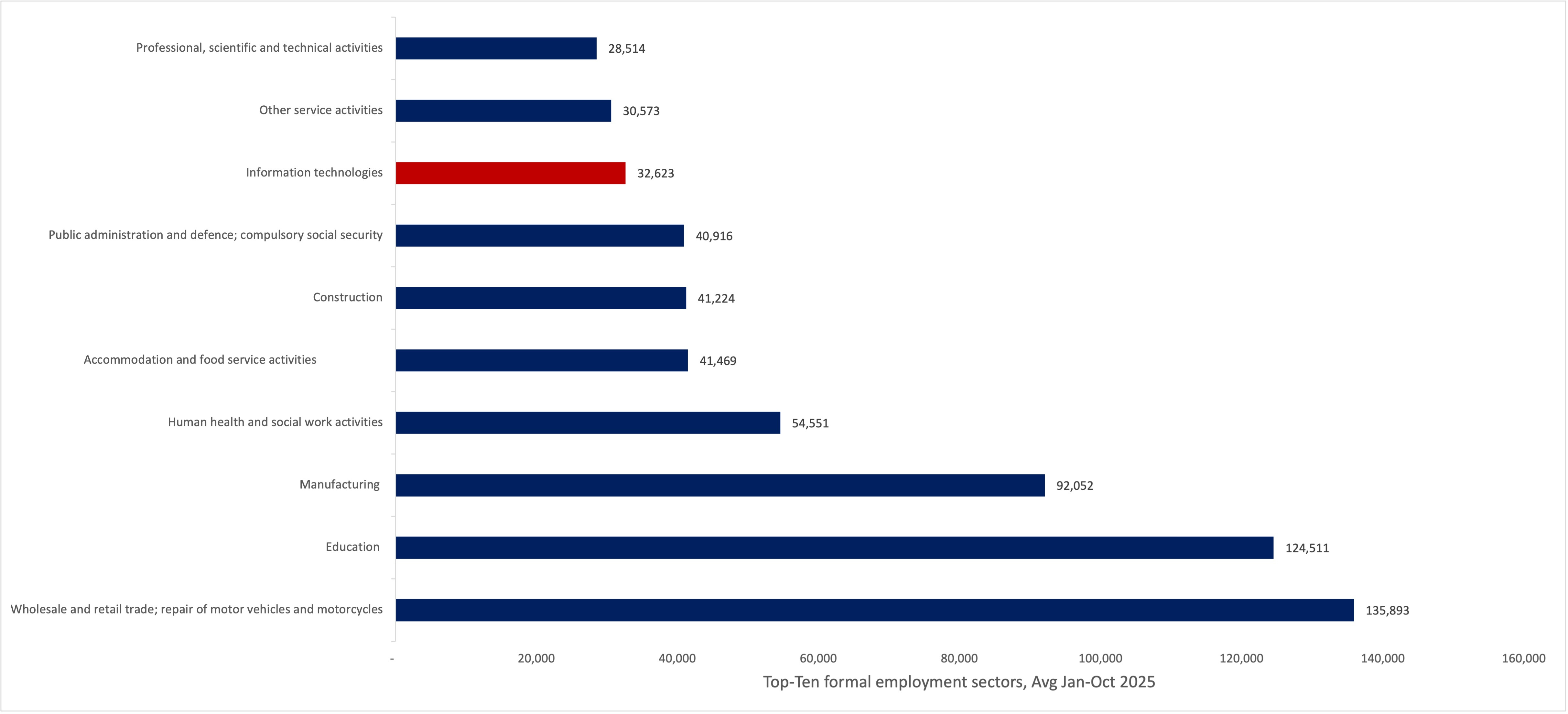
What makes this even more difficult is the affirmation that the ICT employs just a fraction of Armenia’s labor force, in turn almost entirely concentrated in two cities—the capital Yerevan and Gyumri. Instead, majority of the labor force is in lower-paying trade, education, manufacturing sectors (Fig. 5). Armenia’s own statistics point to a large share of informal economy (up to 37% in 2022) overall and in agriculture (up to 65% of all informal employment in 2022). In its 2024 study the World Bank emphasized these labor market disparities that are exacerbating regional divides and worsening economic prospects and inequality.
Where does this leave us? Should the small post-socialist economies scale down on their ICT development efforts?
Absolutely not. The development of the ICT is a welcome outcome with massive potential benefits in the future, leveraging the best of the post-Soviet technical and scientific base.
However, in its current form, the process has to date had limited contribution for the bigger domestic economy’s improvement, especially outside of the ICT urban hubs. Successful experiences, leveraging emerging technologies and constructing foundations for the future potential comparative advantages, of such countries as Japan, South Korea, Malaysia, Taiwan, and, of course, China point to a solution: a well-thought through systematic and pragmatic industrial policy.
Towards systematic, pragmatic, meaningful, and complex industrial policy
In the 1990s the CEE economies (e.g., Czechia, Hungary, and Poland) leveraged their geographic proximity with and popular demand for integration with the European Union. They also relied on their socialist-times strong social, educational systems, and complex industrial infrastructure. The latter had allowed those economies to produce final goods of competitive global quality trading with the West, while the Soviet Union was the backstop for any unsold remainder. Objectively, the outcomes have since been remarkable economic growth and stability.
The smaller post-socialist economies in the CCA are denied of such luxuries. Neither in geography nor with their simple (if, any) physical manufacturing core do these economies have a significant edge as their CEE peers. Therefore, the evident push for intangible ICT sector.
But the ICT push should be seen as just a necessary step. Innovation for exports alone cannot be a far-sighted strategy. There are at least two reasons. First, firms in the ICT-export-only sector produce intermediate goods for foreign markets with minimal technological spillover into/engagement with the local economy. And though international trade theory might suggest a neat solution of country’s specialization in an export good production, this does not happen in realities of the small economies. Second, workers employed in the exports sectors earning surplus wages, significantly above the national average, in addition to pushing up domestic inflation in real estate and consumer markets (they can pay more) are also spending (and saving) excessively abroad (and the e-commerce of today makes it all very user-friendly and easy)…
So, if we are to consider the ICT as the transformative sector, the sufficient condition for broader economic prosperity would come by way of a comprehensive and meaningful state-led economic policy integrating the ICT with and spreading its gains across the rest of the economy.
By doing so, the cross-industry links solidify and grow adding to the macroeconomic resilience eradicating oligopolistic capture of economic gains akin the 1990s crises. Encouraging ICTs connections with well-funded research in every field, from humanities and social sciences to technical disciplines becomes an essential condition. That also means departing from a one-city model (in Armenia and Georgia, the capital cities generate up to 65% of the national GDP) developing adaptive economic policy approaches with a specific focus on the regional development, a la Yuen Yuen Ang’s description of China. It also means embracing a meaningful distributional policy of fair taxation and encouraging high-earners’ domestic spending.
Eric Reinert reminds us, again, that no economy on today’s map has reached its advanced status simply relying on the uncertain graces of market forces. Adam Smith himself invokes the need for state intervention for competitive industrial development (but this, too, is best left for another discussion). Examples of such state-led policy could include requirements on final goods/services production, just as it was in South Korea; or push for innovative solutions as in Japan; or adaptation and cross-regional competition in creating country-wide industrial zones as most recently in China. Mariana Mazzucato’s “mission economy” makes a compelling reading on the above.
In the end, the smallest of the post-socialist world are not in a simple situation. The way out of it is to gather the political will to diagnose the problem quickly and objectively, while openly learning from own and global experiences. As new technology upends global macroeconomic tenets, the small post-socialist “late industrializers” still have a chance if act now. ###
This is a thoughtful and well-structured discussion, especially in how it links economic complexity to historical path dependence rather than treating recent gains as purely reform-driven.
One nuance that may be worth pushing further is how much of the observed improvement reflects endogenous capability-building versus exogenous trade re-routing. When complexity gains are driven primarily by re-exports and transit trade, they can temporarily lift ECI readings without materially strengthening domestic productive depth.
In that sense, the core question may be less about whether digital services or ICT can grow fast, and more about whether they are being institutionally integrated into a broader industrial ecosystem. Without that integration, the risk is not stagnation, but fragility masked as progress.
Your emphasis on history is therefore exactly right — not as context, but as constraint.