

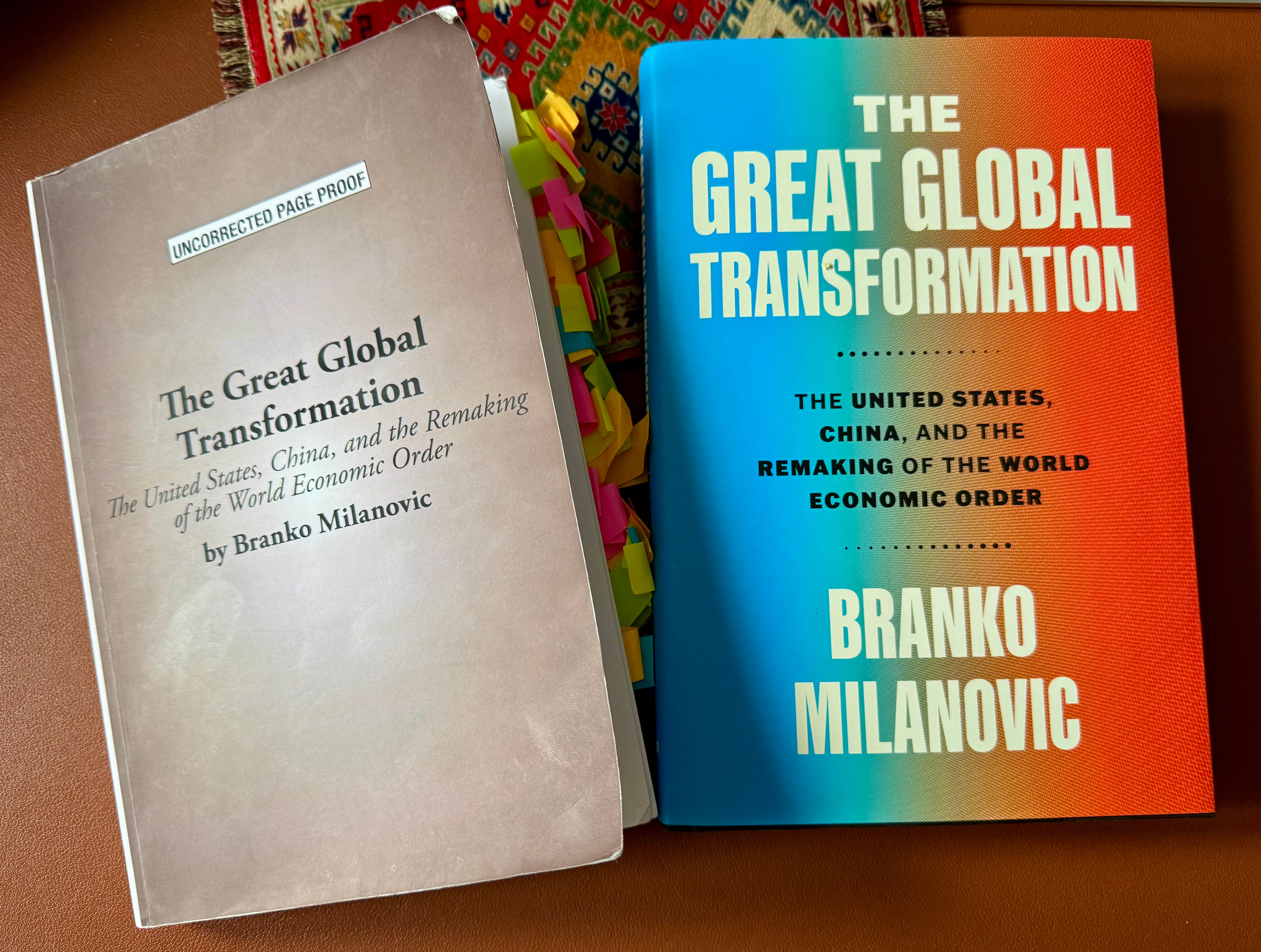
‘Nationalism, Greed and Property’ is the title of a six-page chapter in Branko Milanovic’s The Great Global Transformation: The United States, China, and the Remaking of the World Economic Order that has recently been released by the Chicago University Press. The chapter is probably the most important in the book (GGT) as it is also an essential summary of Professor Milanovic’s entire body of work as of now. Here’s why.
The chapter is a dialectical construct of a complex social transformation of our times: emergence of economic and political nationalism. The latter has manifested itself with its own set of known (and probably yet to be discovered) policy measures. Those range from tariffs, sanctions, to policies controlling population flows and information access restrictions. Ultimately, countries with adequate economic, human, and institutional resources (there aren’t many like that) will act strategically in their own interest, influencing the socio-economic outcomes at home and for the structurally smaller and weaker nations. Diplomatic and military clashes are on the agenda as well.

Milanovic explains that the ascent to this condition begins with private property, moving to greed, and then on to nationalism. This is a historical dynamic the mechanics of which are self-reinforcing at each stage. And a new spiral ascent begins once each full stage is passed.
Private property needs to be secured as the world produces increasingly more and commodification of those new products grows. New production is often intangible, e.g., social media, digital products, access to data, and as such capitalist property lines need to be clearly delineated. That allows for capitalism’s horizontal and vertical advancement. The horizontal movement is in capitalism’s spread into new geographical areas either for production and commercial purposes, often displacing the locally pre-existing modes of production. Milanovic mentions the process of privatization in the post-socialist economies of Central and Eastern Europe (CEE) and former Soviet Union (FSU) as an example property controls reallocation. Here, de-industrialization and effective dependence on manufactured imports with massive outflows of working age population have become the reality for many small CEE and FSU nations.
Capitalism’s vertical movement captures the technological advancement that makes such expanded and diversified production possible. An example can be the common practice by digital platforms of breaking up a whole product, for example with digital media or online video streaming licensing or geographic restrictions, requiring the user to pay for each component separately rather than offering a product (e.g., film series).
But the more we have, the more we want. Greed is derived from each individual property owner to expand their tangible and intangible holdings. That comes also not in terms of actual material possessions but in terms of experiences. This is not just a story of some high-net worth rare art collector. The key feature of Milanovic’s argument is that the need to own more has permeated every fiber of our society. It may not involve every member of the society individually (or not yet) but the dynamic is prevalent enough to concern all. And it is not enough to own something. The modern culture pushes us outside, e.g., online, to share that experience.
“Greed is extrinsic” and “spreads to all activities” argues Milanovic. It is as if the world is now living in a Veblenesque society, where consumption and ownership are put on display, validating the individual’s worth through external audience’s recognition whether it is in the industrialized Western societies or in the grotesque post-socialist realities. Greed is relative, always seen in comparison either to other individuals or nations or to one’s previous economic conditions. Left unconstrained and thriving in the institutionally porous social environment, greed has no limits and is quickly scaled up.
From these two foundational elements, private property and greed, nationalism is derived based on “the fear that our goods, if not sufficiently well protected, may be taken by others…” (p. 197). Another country’s ability to produce more (and better quality) of the same product compared to its peers is often seen as such a threat to the stability and prosperity at home. Protection of one’s property is guaranteed by their belonging to a community (nation). Therefore, the nation-state becomes “a tool” that guarantees the preservation of property and its continuous growth.
Economic and political nationalism is then justified and nurtured, expanding to forever preserve the “never-satiated mass plenty.” That is the continuous spiral ascent. But the way we achieve that “forever”, Branko Milanovic concludes, is through wars.
If this echoes the history of mercantilism, it’s by intention. The warring city-states in Italy accomplished a great deal, each accumulating massive wealth. But unable to overcome the mercantilist dogma they eventually had to yield the economic dominance reigns to their competition elsewhere (an insightful take on related can be found in Bas van Bavel’s The Invisible Hand?). And, yet, their fascinating consistency of wealth preservation across generations can only be matched by the high-tech magnates of our times.
How did we get to this? To answer this question, one would have to read the Great Global Transformation from the beginning.
The GGT tackles these complex questions analytically deconstructing the very visible ongoing change of the global economic and, by extension, political order. We are witnessing a break-down of the last century’s model, the end of the neoliberal era of the global economy. It is this monumental transformation that links this book to Karl Polany’s The Great Transformation.
Back in the early 1990s, as the competition between the capitalist and socialist systems abruptly ended with the dissolution of the Soviet Union, no other alternative held a greater appeal than the neoliberal economic system. It is significant that Milanovic opens the GGT’s with a memory about the market transitions in late 1980s-early 1990s in CEE and FSU. For him the resolution of the socialist economic crisis was possible through introduction of features of capitalism, but retaining key determinants of socialism. After all, had not something similar only in the opposite direction—expanding the role of the state—been tried in resolving the Great Depression?
Rethinking central planning system was not new, as Yakov Feygin reminds us in his insightful and powerful deep dive into Soviet economic history in his Building a Ruin. By late 1980s, the perestroika movement was positioned to preserve socialism giving it a new look, so to speak. But the internal contradictions of the Soviet-style socialist system did not withstand the pressure of time.
The neoliberal alternative’s emphasis on globalization, trade openness, and cheaper-priced imports turned out to be equally seductive for CEE and FSU but also for the rest of the world. All were welcome to the banquet and all stood to gain materially. The world moved from an antagonistic rivalry of two ideological opposite camps to a U.S.-led economic and political unipolarity. For a moment, it seemed that the human civilization landed in a long-awaited balanced condition.
Yet, history has a persistent drawback of non-linear evolution and capitalism follows more than one development path. In his other, no less fundamental, book—Capitalism, Alone (CA)—Milanovic asserts that today, while all countries are capitalist, there are two major types of capitalism. The first one he calls meritocratic capitalism, which is broadly linked to the free-market oriented system of the U.S. economy. The second is the political capitalism. This one is an economic system with its own internal competitive dynamics but with a heavier regulatory participation of the official state; and here China is the main example.
One should read CA as an intellectual prequel to the GGT. The first book helps to analytically catalogue the diversity of global economic outcomes of significant importance. The second book in turn helps us to draw a critical evaluation of the present and attempts to conceptualize the future. In this setting the individual national (now) capitalist systems are competing against each other according to their own rules… (or no rules, at all, as it might seem). Milanovic defines the newly emerging socio-economic arrangement as the national market liberalism.
In this context, nations act strategically rather than in adherence to some common set of rules. For Milanovic this is a cardinal deviation from the post-WWII rules-based world order and even from the 1990s unipolar environment. Maintaining liberal economic regimes internally, countries now rely on a range of economic and political instruments when it comes to their engagement with the foreign counterparties. The toolkit is diverse and filled with policy options such as tariffs, unilateral sanctions of diverse nature, border controls, technological embargoes, and more. It turns out, mutual trade relations alone are not enough to hold the world in balance, despite the much hope put into such condition by classical philosophers and economists whose work Milanovic explores in the GGT as well.
According to the GGT the current new system emerges from the ongoing processes that can also be referred to as globalization-in-reverse. Here the centrifugal forces of national enrichment (and preservation of plenty) pull each country’s economic potential back into either its borders or to their trade and political alliances. The unified global economy is fractured as the national market liberalism leads to emergence of many cross-border alliances. Those in turn are likely to outgrow their economic confines and branch into political and military unions. The world economy is still globalized but is de-globalizing. The small and structurally weaker countries are at the greatest disadvantage here, forced to find their development model in this new world. For majority, alliance with the largest trading partner will be a hard choice.
Milanovic connects the ongoing processes with the retreat of the neoliberal economic paradigms. Originating in the late 1970s-early 1980s and acquiring new breath in the post-socialist movements of the 1990s, that economic and political agenda has already exhausted and outlived its purpose. At some point by early 2000s, and peaking during the 2008 Global Financial Crisis, the same neoliberal economic globalization started to backfire. Instead of promoting the enrichment of the industrialized West, according to Milanovic, globalization brought on stage new players that were strong in macroeconomic terms, saw their income levels and living standards markedly improve in short period of time, and remained institutionally more in control than the West.
Now, the economic rise of the likes of Brazil, China, India, Russia, and others—a product of success of the globalization project—has manifested, first autonomy and later, independence from the conscripts of the neoliberal model throwing a challenge to the world and ushering a new multipolar world. Here, China’s economy is a dominant global contender to the post 1990s unipolarity. All these are dynamics that have been perceived as threats to the established world order, as Milanovic articulates through his analysis of macroeconomic fundamentals. Though Yuen Yuen Ang call for polytunity, instead, as an opportunity of “a generational opening for deep transformation.”
But there is more and Milanovic anchors his discussion with the empirical observations from his work on global inequality—a field in today’s economics that he almost single-handedly carved out despite the headwinds of the reactionary profession. As he documents in CA, and then develops in the GGT, the global inequality balances have reshuffled as well. While the emerging markets have seen their standards of living improve, driven by fast economic growth (the sources of which are outside of scope of this essay), the middle classes of advanced economies have seen their incomes stagnate over the past three decades. In a long list of empirical studies available today supporting this statement, the elephant curve analysis, published by Christoph Lakner and Branko Milonovic in 2013, was one of the first indicators of the changing global economic balance.
As such, the core explanation for the emerging multipolarity and more aggressive geopolitics harks back to the individual elements of private property and greed discussed above. In this context, the nation-state is a disrupter but also the conduit of whatever the most influential interests might be in a given society (whether that is fair matters not).
For an informed and curious scholar, Branko Milanovic’s work, of which the GGT is the latest installment (if not a culmination to date), is an absolute must follow. His ability to synthesize a multifaceted phenomenon, stripping the noise and presenting the dialectical gist of the problem, is unsurpassed in today’s analytical writing. Leveraging highly complex empirical data with his deep understanding of economic history in The Great Global Transformation Milanovic unveils the sophisticated essence of the economic, political, and social processes of our time.
There is a lot to go through and not everything in the book may resonate with the morals of the reader. Nevertheless, the GGT is one of the most important methodological attempts of our times explaining the evolving reality and peeking into the future. Perhaps the book may inspire a fairer, balanced, a calmer world… although, somewhat paradoxically, today this sounds more as a hope from the tumultuous 1990s.
@devlin