

“So, professor, how do we correct economics? What does it mean to be an economist?” asked me Nathan Greene, my former student at our St. John’s University (and who has his own Substack that you should read), about a month or so ago… My effort to come up with a meaningful answer sent me into a conflicting whirlpool of ideas and thoughts desperately trying to explain something incredibly complex but in straightforward terms. For remember the classroom adage: if one has a question, everyone has the same question. Hence, an attempt to reason through the challenge is warranted.
The outcome of this intellectual exercise is now an hour-long podcast: a conversation between Nathan (the host) and me. The podcast, recorded in August 2025, has just been released by the Henry George School of Social Science as part of their Rethinking Economics program and the specific sub-series on economics as an academic discipline.

This turned out to be an interesting conversation that also helped me articulate some of my thinking about our discipline and its foundational place in business studies and policy applications.
There is no lack of such discussions, of course. The latest installment to the ongoing debate, coincidentally published just a day or so ago, is by Tim Harford writing in the Financial Times on “The wrong kind of maths: why the mathematics used in economics for decades needs a rethink.” In a nutshell, the argument that Harford is making is that mathematics is a required part of economics but the problem is that math needs to be more in tune with the social science feature of economics vs. being math for the sake of math.
It’s hard to disagree with this view and we reflect on a related topic in our podcast, but we also go beyond that. There are, essentially, two points to highlight from our conversation with Nathan.
First, it is important to realize that the technical core of economics education does not make up the entire discipline. Often, we mistake the aggrandization of the dry theoretical or empirical exercises in economics for the actual substance of our research, degrading the meaningful guidance that the discipline is capable of providing in business uses and to policy makers. This happens, often, with over-mathematization of economics a la Tim Harford’s “wrong kind of maths.” The profession ends up producing academic papers of 70 and more pages that in the past would have been considered as short monographs. It is worth noting, as I mention in the podcast, Michal Kalecki’s The Principle of Increasing Risk (1937), was just a seven-page paper that if one reads it closely will help understand the business cycle and speculative debt build-up ahead of economic crisis (see my review of the paper). Unfortunately, today’s long papers, an outcome of peer-review pressures and established mistaken demand for technical rigor, are great in developing a battery of robustness checks but, sadly, often fail to shed much light on the actual economic problem at hand.
This is where the “non-technical” courses in economics become critical in enriching our discipline’s outlook. Of course, there is a broad list of elective courses from International Economics (and separately, trade and finance), to Environmental, Labor Economics, in some cases (like we have at St. John’s) Economics of Poverty and Inequality, but also, Economics of Money and Banking, Economic Development, Behavioral Economics, Business Economics and more.
What is missing from that standard list of subjects are two courses: Economic History and History of Economic Thought. In my opinion, as I explain on the podcast, these two are essential courses for a modern-day economics program. These two classes provide the necessary background context, which then helps in economics training and application, orienting an economist on a vast landscape of socio-economic problems not as some always random phenomena but as something that systemically evolves through the complexity of social interactions and policy decisions over time. These two courses motivate students to read diverse literature in economics and across-disciplines, helping develop those delicate intellectual connections informing and supporting the versatility of our profession.
It is likely, in other words, that a “novel” problem we are dealing with today has appeared in the past with an accompanying existent body of literature reflecting on the issue, with a chance guidance on developing our own solutions.
The best example, I can think of right now, of such approach is Branko Milanovic’s incredible Visions of Inequality: From the French Revolution to the End of the Cold War (which I reviewed for the LSE Review of Books). Needless to say, there is a sense of some pride that my college and university have both Economic History and History of Economic Thought as part of the undergraduate course offering.
But that does not mean that one should be lost in history, detached in popular view from reality. On the contrary, and that is the second point I try to emphasize in the podcast. When asked what type of economist I’d want my students to become, my answer was “a real economist.” And what I mean by that is today’s economist must be firmly standing on the ground embracing the broad and rich horizon of socio-economic realities with a solid understanding of empirical tools and data. That is what should be informing our research, policy advice, and myriad business applications of economics.
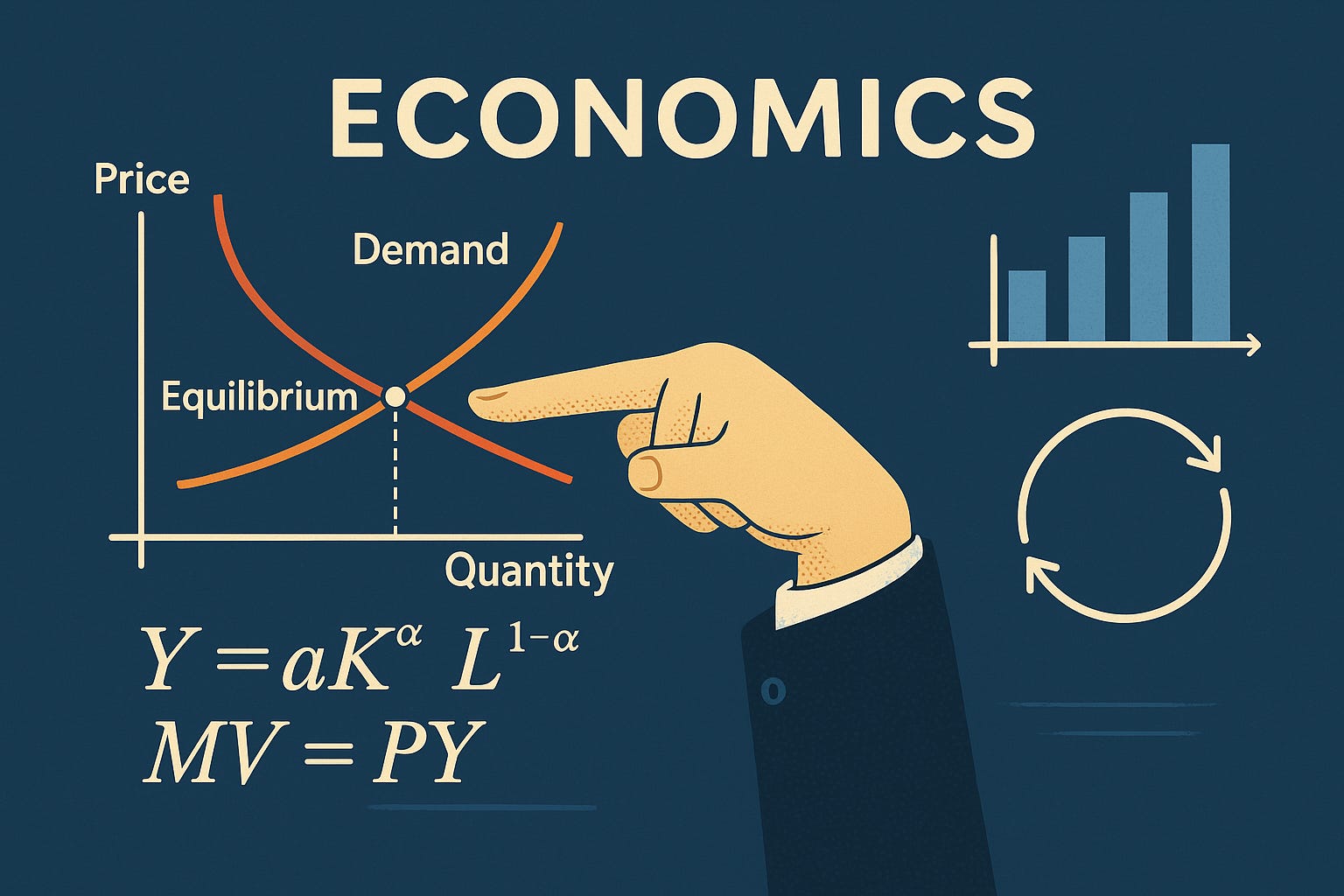
The above also means being connected to the real-life’s pulse outside office windows, appreciating the dynamic nature of an economic system as opposed to a static equilibrium. Technical skills aside, the uniqueness of a real economist is in their ability to think in non-linear terms, different than the trend and still being able to tell a story that is meaningful to a given environment.
It is precisely for these reasons that economics, as a discipline, remains at the center foundation of any serious business studies program. But the ability to reason in multidimensional terms merging contradictory frameworks is hardly a self-evident outcome of economics training. Instead, and this is the “correction” from above, nurturing such skills requires a conscious effort of going beyond clear-cut rigor and, instead, facing the social complexity in a systemically informed way.
I invite you to listen to our conversation, as I think it may resonate with many economists and non-economists alike curious about the purpose and relevance of modern economics.
I’m thankful for any feedback and your support of this column; so please do read / share this Substack and encourage others to subscribe. And let’s keep the conversation going.
###
Good job, Alex.