
De-industrialization, primate city, and income inequality after socialism…
Despite their World Bank’s upper-middle-income classification, the small open post-socialist economies do not present an obvious story of sustainable economic growth and prosperity.


Despite their World Bank’s upper-middle-income classification, the small open post-socialist economies do not present an obvious story of economic growth and prosperity. In this update, we are continuing the earlier conversation about post-socialist transformations (e.g., started here and here). The countries at hand are small—both in territory, population, and in economic terms— nations that are often overlooked in grand discussions on worldly matters.
Consider Figure 1, which shows changes in average shares of value added in manufacturing and services sectors relative to GDP for all CEE and FSU countries. The data are from the World Bank’s World Development Indicators and the average directional trends are sufficient for our purposes here.
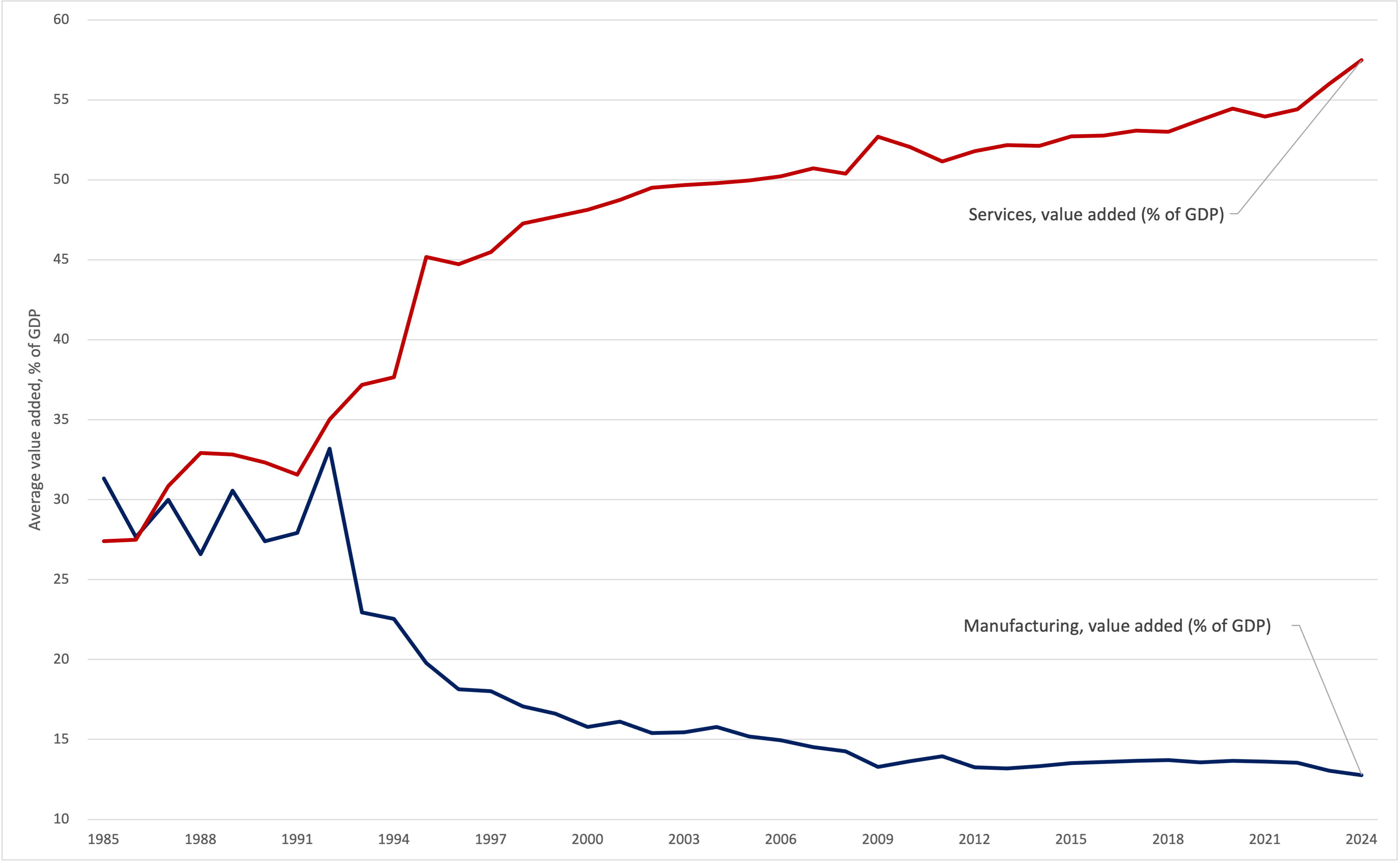
Across the entire group, on average the manufacturing base eroded precipitously in the early 1990s as the socialist economic system collapsed. Subsequently, the share of manufacturing in the economy continued to decline even among those (like Belarus, Czechia, Poland) that have sustained comparatively high (~20% of GDP) shares. But for majority, as the borders opened to international trade, domestic manufactured goods lacked in their consumer appeal and affordability (and availability), while cheaper, better quality, and aesthetically nicer imported alternatives flooded the markets.
Interestingly, clothing, and basic household items (even before the electronics) drove the change, just like in the 19th century industrial revolution, only now it was in reverse direction. If perfecting and expanding textile production in the industrializing West laid the foundations for the 20th century manufacturing prosperity; then in the post-socialist context imported clothing and consumer goods, in the background of political instability, delivered a forceful destructive impact displacing domestic production, leading to enterprise closures, and mass layoffs. The socialist system of guaranteed employment and guaranteed market demand no longer existed.
The real winners at the time (and still) were the burgeoning sectors of retail and wholesale trade, included in the WB’s “services” category alongside with more recent contributions from the tech sector. That explosion of trade in the early 1990s explains the almost sudden jump in the services sector trend (Figure 1), while manufacturing, even if deficient in quality compared to its Western peers but yet superior in its complexity to trade, declined beyond restoration. The loss of industries and with that of practically any technological capacity that existed was colossal in its significance for the small economies and their labor markets (e.g., up to 70 percent losses in economic capacity in Georgia, for example).
In Erik Reinert’s construction, to whose work we referred earlier, manufacturing represents a higher-order complex productive and coordination activity compared let’s say to trade. Manufacturing (whether labor- or machine-intensive) is what sets the economic capability standard and defines geopolitical outcomes for a small country. Leapfrogging into a new economic development stage without the underlying explicit link between the growing services sector and that of manufacturing backbone is not possible.
Skipping some political economy details here, recall that Reinert describes these developing economy’s de-industrialization processes as economic “primitivization” and loss of urban economies (in the book, he uses examples of Mongolia and Peru but alludes to the post-socialist economies as well). The latter is in reference to the major role of urban centers (true so in the socialist past) as the key industrial hubs with diverse economic structure, actual economic complexity. And that has been the fate of many small post-socialist economies.
So, it is interesting then that if we look at Figure 2 now for some small open post-socialist economies (here we have five) the role of urban economies seems to have further risen after socialism. Indeed, with possible exception of Serbia, the greater part of economic activity is now increasingly concentrated in the nations’ capitals, which have also become the undisputed political and cultural centers, a la Mark Jefferson’s 1939 primate cities.
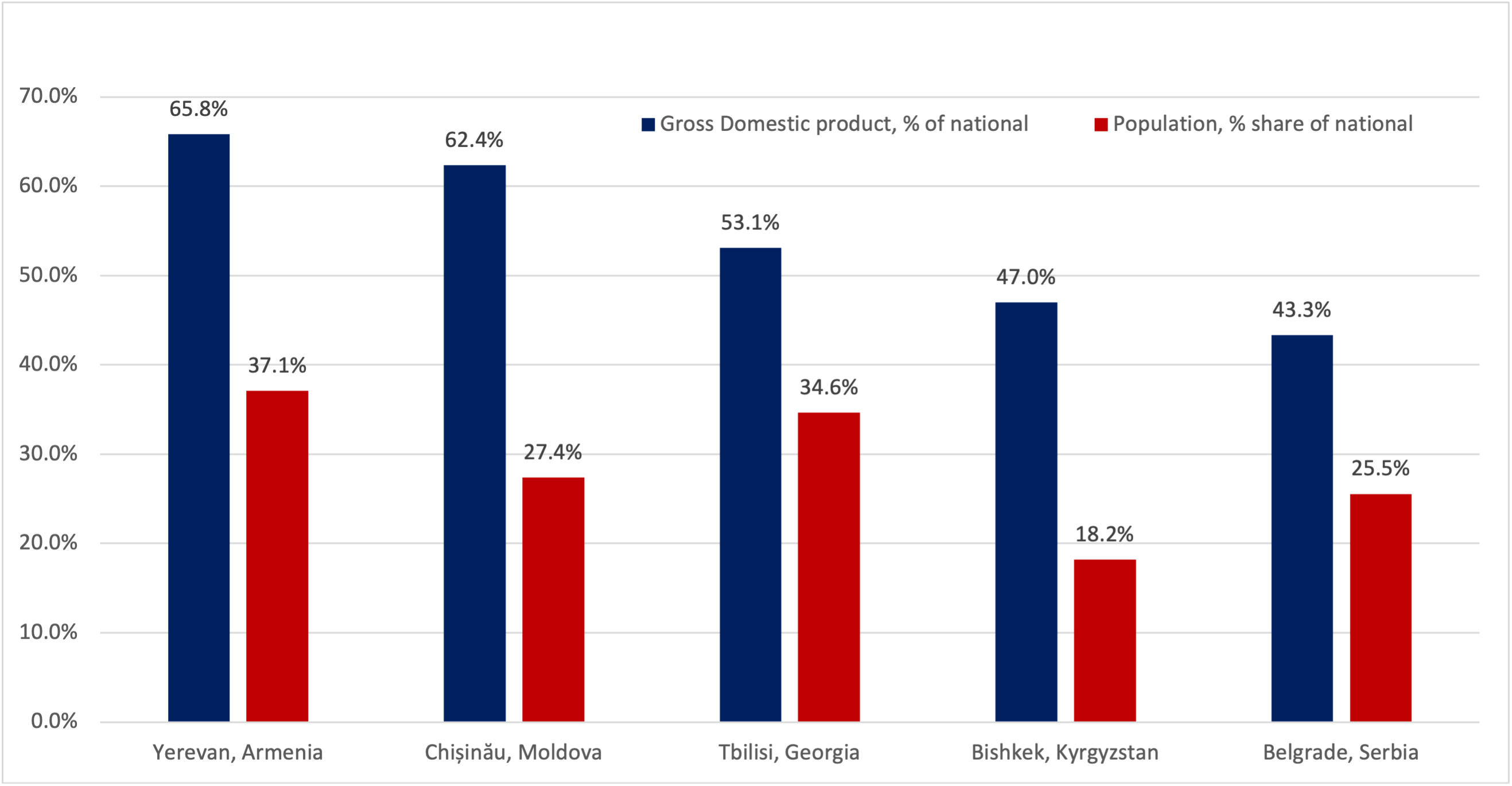
These large and growing metropolitan areas are also the cities where most of the country lives (and with that, larger share of the national labor force), stretching the sustainability limits of an urban economy and exacerbating the unevenness of national economic development and growth. These macroeconomic and population shares in the capital city are much lower elsewhere in the post-socialist world, especially those integrated within the European Union (e.g., Czechia, Hungary, Poland).
The contrast is much sharper when the estimated share of the capital city population is controlled for urban areas only. There may be an argument justifying existence of a primate city-like arrangement. It is possible to envision that a large city in the otherwise strong and diversified macroeconomic environment may have positive spillover for the rest of the country by way of economies of scale.
But the evidence from the post-socialist economies (that in this regard are following a standard large-city growth typical to developing economies elsewhere) suggests that such economic and demographic bias towards one city is usually characterized by intra-city unequal economic outcomes, increasingly growing social divides, inequalities, and widening development disparities between the capital and the rest of the country’s regions (e.g., captured in yet another earlier World Bank report).
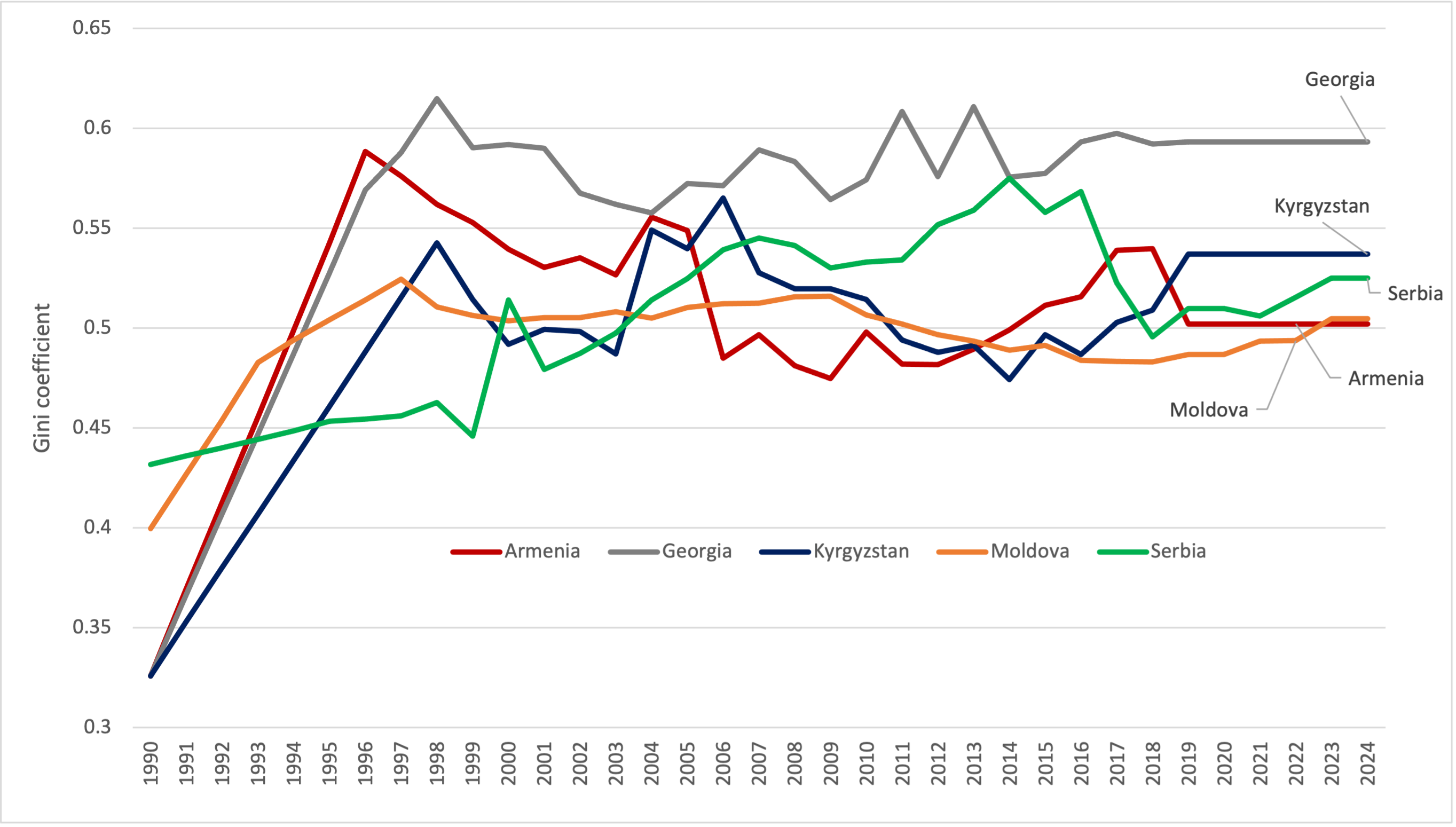
Looking at the income distribution outcomes after socialism (based on the data from the World Inequality Database arranged in Figure 3) it becomes evident that the leapfrogging model, mentioned above, did not work. The new economic conditions did not elevate incomes widely across the economy as the manufacturing sector faded out and productivity and pay continued to decline in agriculture (one of the largest employers across rural areas) vis-à-vis the urban services sectors employing smaller population shares (discussed here).
As history would have it, the rise of unemployment and sharp contrasts in economic inequality (a significant break from a more balanced socialist past) in the first two decades of transition would lead to massive migration outflows of people from the small post-socialist economies and, especially, from the five countries mentioned here, with all the subsequent effects of brain drain and some temporary relief to those remaining by way of monetary remittances.
In many ways the established highly unequal distributions across the small post-socialist economies feed into Branko Milanovic’s maxim on The Haves and the Have-Nots…and the famous “citizenship premium.” If we fast-forward to our times, we learn that the 2020 COVID-19 pandemic exacerbated the pains of low-income groups in the small economies constrained by their minimal fiscal capacities.
The break with the past is clear in Figure 3 as Gini coefficients stratospheric and fast increases suggest for all five countries. Recall that the closer the Gini coefficient is to zero the more fair (equal) is the income distribution. Similarly, as Gini approaches one country’s income concentration increases, with Gini=1 meaning one person earns all of the national income. Looking at Figure 3, once the 0.45 levels are breached, the coefficient stays high and, in some cases, goes higher across all five countries.
In other words, these small, relatively closely-knit, societies with high population density concentrated in their primate-cities are facing dramatic contrasts in economic living standards, income inequality, and opportunities in life. The excesses that are easily diluted in the larger societies and kept away from the public eye, are out there in the open on a daily basis in these small economies, effectively punching the “have-nots” right in the face with the luxurious lifestyle of high-end fashion and unconstrained spending in restaurants and trips abroad.
These assessments are further corroborated by the country panels in Figure 4 panels. Here, across all five countries the share of Top 1% and Top 10% income earners rise immediately during the 1990s transition. In few cases, e.g., most visibly Moldova and Serbia, the top income earners’ shares continue to increase into the recent years. At the same time the pre-tax income shares of the bottom 50% of earners once declined in the early 1990s remain low and in few cases even below the Top 1% earners’ shares (e.g., Georgia and less so pronounced in some others).


These income disparities suggest existence and worsening of deep socio-economic divisions in the affected societies, as larger population shares are falling behind. Considering relatively high poverty rates, the inequality data paint a troubling picture of social stability and prospects for sustainable economic growth in these countries. The roots of these income distributions, and emergence of the local rich ‘elites’ a la Guido Alfani’s description in his As Gods Among Men, are firmly trapped in the political economy contradictions of the transition era, rent seeking of more recent times, and in the newest twist growth of niche sectors such as ICT. All of that is happening despite visible on the surface unyielding consumer spending of the lower and middle income groups largely financed by consumer loans (in turn boosting growth in financial services and entertainment sectors).
It may then come as a surprise for many but in his often-cited Wealth of Nations Adam Smith expresses his concern for the well-being of a country’s larger population group:
Servants, labourers, and workmen of different kinds, make up the far greater part of every great political society. But what improves the circumstances of the greater part, can never. be regarded as any inconveniency to the whole. No society can surely be flourishing and happy, of which the far greater part of the members are poor and miserable. It is but equity, besides, that they who feed, clothe, and lodge the whole body of the people, should have such a share of the produce of their own labour as to be themselves tolerably well fed, clothed, and lodged. (Book 1, Chapter VIII).
It is for this thought about the prosperity of the larger segment of the population in an economy that in his Visions of Inequality Milanovic refers to Adam Smith as “the most leftist economist” if the latter lived in our times (see my review of the VoI here). It is this improvement in economic conditions of the larger population group that the wealth of nations grows…
Someone once suggested that there are two ways to comment on macroeconomic developments in the post-socialist world. There is a “bottle half-empty” story and a “bottle half-full” view. Which one of the two speaks to the reader more directly is a matter of individual choice.
The bigger point is not that return to socialist economic system would in some way restore income balance and bring well-paying jobs to the small post-socialist economies. It is equally not the point that any manufacturing should be pursued for the sake of manufacturing.
Instead, the point is that the severity of the contemporary macroeconomic challenges and the evident socio-economic gaping contrasts are real and profound in their structurally eroding effect of the small economies’ foundations, despite the veil of economic growth.
Assessing those challenges, requires a conversation that is open to alternative interpretations, evidence-informed, and directed towards applied policy as opposed to dominance of abstract economic modelling.
That would be a much more arduous task, but one with profound positive economic feedback, than simply placing all hopes in the magic of a one export-oriented sector model to somehow solve all problems. That’s not how macroeconomic development works.